Ch. 4 - Laws of Sines and Cosines; Vectors
Blitzer - Trigonometry 3rd Edition
Blitzer3rd EditionTrigonometryISBN: 9780137316601Not the one you use?Change textbook
Chapter 4, Problem 21

In Exercises 21–38, letu = 2i - 5j, v = -3i + 7j, and w = -i - 6j.Find each specified vector or scalar.u + v

Verified step by step guidance
1
Identify the components of vector \( u \) as \( 2i - 5j \).
Identify the components of vector \( v \) as \( -3i + 7j \).
Add the corresponding components of vectors \( u \) and \( v \): \( (2i + (-3i)) \) and \( (-5j + 7j) \).
Simplify the addition of the \( i \) components: \( 2i - 3i \).
Simplify the addition of the \( j \) components: \( -5j + 7j \).

Verified video answer for a similar problem:

This video solution was recommended by our tutors as helpful for the problem above.
Video duration:
1m
Was this helpful?

Key Concepts

Here are the essential concepts you must grasp in order to answer the question correctly.

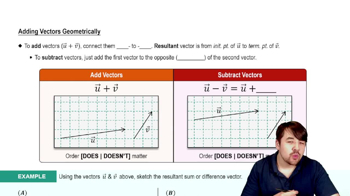
Vector Addition

Vector addition involves combining two or more vectors to form a resultant vector. This is done by adding their corresponding components. For example, if vector u has components (2, -5) and vector v has components (-3, 7), their sum is calculated by adding the i-components and the j-components separately, resulting in a new vector.
Recommended video:
05:29
Adding Vectors Geometrically

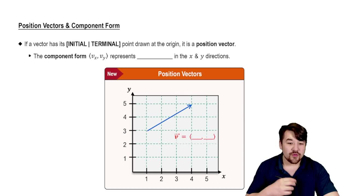
Component Form of Vectors

Vectors can be expressed in component form, typically as a combination of unit vectors i and j in a two-dimensional space. For instance, a vector u = 2i - 5j indicates it has a horizontal component of 2 and a vertical component of -5. Understanding this form is essential for performing operations like addition or subtraction.
Recommended video:
03:55
Position Vectors & Component Form

Resultant Vector

The resultant vector is the vector that results from the addition of two or more vectors. It represents the cumulative effect of the individual vectors. In the context of the question, finding u + v will yield a resultant vector that combines the effects of both vectors, providing a new direction and magnitude.
Recommended video:
05:05
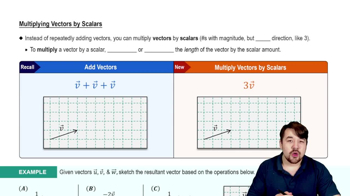
Multiplying Vectors By Scalars