Ch. 4 - Laws of Sines and Cosines; Vectors
Blitzer - Trigonometry 3rd Edition
Blitzer3rd EditionTrigonometryISBN: 9780137316601Not the one you use?Change textbook
Chapter 4, Problem 16

In Exercises 13–16, find the area of the triangle having the given measurements. Round to the nearest square unit.a = 2 meters, b = 2 meters, c = 2 meters

Verified step by step guidance
1
Recognize that the given triangle is an equilateral triangle since all sides are equal: \( a = b = c = 2 \) meters.
Use the formula for the area of an equilateral triangle: \( \text{Area} = \frac{\sqrt{3}}{4} a^2 \).
Substitute the side length \( a = 2 \) meters into the formula: \( \text{Area} = \frac{\sqrt{3}}{4} \times 2^2 \).
Simplify the expression: \( \text{Area} = \frac{\sqrt{3}}{4} \times 4 \).
Calculate the area and round to the nearest square unit.

Verified video answer for a similar problem:

This video solution was recommended by our tutors as helpful for the problem above.
Video duration:
3m
Was this helpful?

Key Concepts

Here are the essential concepts you must grasp in order to answer the question correctly.

Triangle Area Formulas

The area of a triangle can be calculated using various formulas, depending on the information available. For triangles with known side lengths, Heron's formula is particularly useful. It states that the area can be found using the semi-perimeter and the lengths of the sides. For this triangle, since all sides are equal, the formula simplifies the calculation.
Recommended video:
4:30
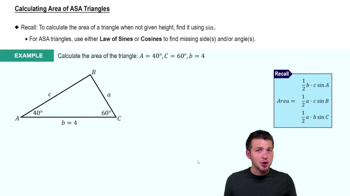
Calculating Area of ASA Triangles

Heron's Formula

Heron's formula allows for the calculation of the area of a triangle when the lengths of all three sides are known. It involves first calculating the semi-perimeter (s = (a + b + c) / 2) and then applying the formula: Area = √(s(s-a)(s-b)(s-c)). This method is particularly effective for non-right triangles, such as the equilateral triangle in this problem.
Recommended video:
6:36
Quadratic Formula

Equilateral Triangle Properties

An equilateral triangle has all three sides of equal length and all angles measuring 60 degrees. This symmetry simplifies calculations, as the height can be derived from the side length. For an equilateral triangle with side length 'a', the area can also be calculated using the formula: Area = (√3/4) * a², which provides a quick way to find the area without using Heron's formula.
Recommended video:
4:42
Review of Triangles