Ch. 3 - Trigonometric Identities and Equations
Blitzer - Trigonometry 3rd Edition
Blitzer3rd EditionTrigonometryISBN: 9780137316601Not the one you use?Change textbook
Chapter 3, Problem 87

In Exercises 85–96, use a calculator to solve each equation, correct to four decimal places, on the interval [0, 2𝝅). cos x = οΉ£ 2/5

Verified step by step guidance
1
Rewrite the equation clearly: \(\cos^2 x = -\frac{2}{5}\). This means the square of cosine of \(x\) equals a negative number.
Recall that \(\cos^2 x\) represents the square of the cosine function, which is always greater than or equal to zero for all real \(x\) because squaring any real number cannot produce a negative result.
Since \(\cos^2 x\) cannot be negative, analyze the equation \(\cos^2 x = -\frac{2}{5}\) and recognize that it has no real solutions because the right side is negative.
Conclude that there are no values of \(x\) in the interval \([0, 2\pi)\) that satisfy the equation \(\cos^2 x = -\frac{2}{5}\).
Therefore, the solution set is empty; no solutions exist for this equation within the given interval.

Verified video answer for a similar problem:

This video solution was recommended by our tutors as helpful for the problem above.
Video duration:
3m
Was this helpful?

Key Concepts

Here are the essential concepts you must grasp in order to answer the question correctly.

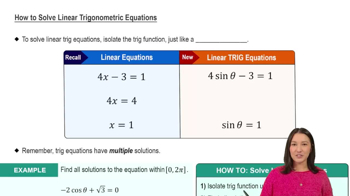
Solving Trigonometric Equations

Solving trigonometric equations involves finding all angle values within a specified interval that satisfy the given equation. This requires understanding the periodic nature of trigonometric functions and applying inverse functions to isolate the variable.
Recommended video:
4:34
How to Solve Linear Trigonometric Equations

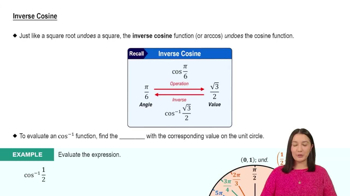
Using the Inverse Cosine Function

The inverse cosine function, denoted as cos⁻¹ or arccos, is used to find the angle whose cosine value is known. Since cosine is positive in the first and fourth quadrants, solutions must be considered accordingly within the interval [0, 2Ο€).
Recommended video:
4:49
Inverse Cosine

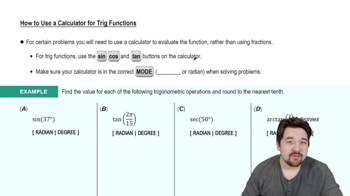
Calculator Use and Rounding

Using a calculator to solve trigonometric equations involves inputting values correctly and interpreting results in radians or degrees as required. Rounding answers to four decimal places ensures precision and consistency in the final solutions.
Recommended video:
4:45
How to Use a Calculator for Trig Functions