Ch. 3 - Trigonometric Identities and Equations
Blitzer - Trigonometry 3rd Edition
Blitzer3rd EditionTrigonometryISBN: 9780137316601Not the one you use?Change textbook
Chapter 3, Problem 3.3.58a

In Exercises 55–58, use the given information to find the exact value of each of the following:
a. sin(α/2)
sec α = ﹣3, 𝝅/2 < α < 𝝅

Verified step by step guidance
1
Identify the given information: \(\sec \alpha = -3\) and the interval \(\frac{\pi}{2} < \alpha < \pi\).
Recall the relationship between secant and cosine: \(\sec \alpha = \frac{1}{\cos \alpha}\). Use this to find \(\cos \alpha\) by taking the reciprocal of \(\sec \alpha\).
Determine the sign of \(\cos \alpha\) in the given interval. Since \(\frac{\pi}{2} < \alpha < \pi\) corresponds to the second quadrant, where cosine is negative, confirm that \(\cos \alpha\) is negative.
Use the Pythagorean identity \(\sin^2 \alpha + \cos^2 \alpha = 1\) to find \(\sin \alpha\). Substitute the value of \(\cos \alpha\) and solve for \(\sin^2 \alpha\).
Determine the sign of \(\sin \alpha\) in the given interval. Since sine is positive in the second quadrant, take the positive square root to find \(\sin \alpha\).

Verified video answer for a similar problem:

This video solution was recommended by our tutors as helpful for the problem above.
Video duration:
5m
Was this helpful?

Key Concepts

Here are the essential concepts you must grasp in order to answer the question correctly.

Trigonometric Functions and Their Relationships

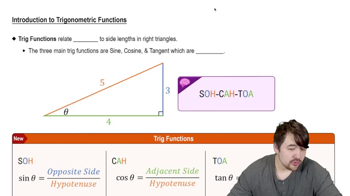
Trigonometric functions like sine, cosine, and secant describe ratios of sides in a right triangle or coordinates on the unit circle. Understanding how secant relates to cosine (sec α = 1/cos α) is essential to find sine values from given secant values.
Recommended video:
6:04
Introduction to Trigonometric Functions

Unit Circle and Angle Quadrants

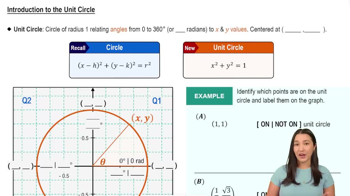
The unit circle helps determine the sign and value of trig functions based on the angle's quadrant. Knowing that α lies between π/2 and π places it in the second quadrant, where sine is positive and cosine (thus secant) is negative, guiding the correct sign choice.
Recommended video:
06:11
Introduction to the Unit Circle

Pythagorean Identity

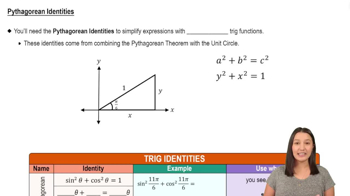
The Pythagorean identity, sin²α + cos²α = 1, allows calculation of sine when cosine is known. After finding cos α from sec α, use this identity to find sin α, ensuring the correct sign based on the quadrant.
Recommended video:
6:25
Pythagorean Identities