Ch. 3 - Trigonometric Identities and Equations
Blitzer - Trigonometry 3rd Edition
Blitzer3rd EditionTrigonometryISBN: 9780137316601Not the one you use?Change textbook
Chapter 3, Problem 3.5.53

In Exercises 53–62, solve each equation on the interval [0, 2𝝅). (tan x - 1) (cos x + 1) = 0

Verified step by step guidance
1
Recognize that the equation is a product of two factors equal to zero: \((\tan x - 1)(\cos x + 1) = 0\). According to the zero product property, set each factor equal to zero separately: \(\tan x - 1 = 0\) and \(\cos x + 1 = 0\).
Solve the first equation \(\tan x - 1 = 0\) which simplifies to \(\tan x = 1\). Recall that \(\tan x = 1\) at angles where the sine and cosine are equal in magnitude and sign, specifically in the first and third quadrants within \([0, 2\pi)\).
Find the general solutions for \(\tan x = 1\) on the interval \([0, 2\pi)\), which correspond to \(x = \frac{\pi}{4}\) and \(x = \frac{5\pi}{4}\).
Solve the second equation \(\cos x + 1 = 0\) which simplifies to \(\cos x = -1\). Recall that cosine equals \(-1\) at the angle where the terminal side points directly to the left on the unit circle.
Find the solution for \(\cos x = -1\) on the interval \([0, 2\pi)\), which is \(x = \pi\). Combine all solutions from both equations to get the complete solution set.

Verified video answer for a similar problem:

This video solution was recommended by our tutors as helpful for the problem above.
Video duration:
8m
Was this helpful?

Key Concepts

Here are the essential concepts you must grasp in order to answer the question correctly.

Solving Trigonometric Equations

Solving trigonometric equations involves finding all angle values within a specified interval that satisfy the equation. This often requires isolating trigonometric functions and using their known values or identities to determine solutions.
Recommended video:
4:34
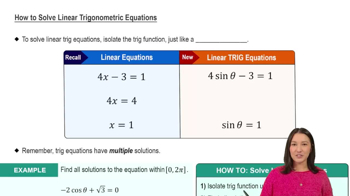
How to Solve Linear Trigonometric Equations

Zero Product Property

The zero product property states that if the product of two factors equals zero, then at least one of the factors must be zero. This allows the equation (tan x - 1)(cos x + 1) = 0 to be split into two simpler equations: tan x - 1 = 0 and cos x + 1 = 0.
Recommended video:
05:40
Introduction to Dot Product

Trigonometric Function Values and Unit Circle

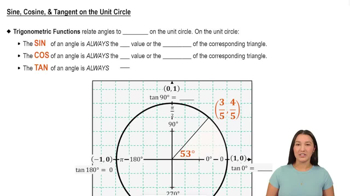
Understanding the values of tangent and cosine functions on the unit circle is essential. For example, tan x = 1 corresponds to angles where sine and cosine are equal, and cos x = -1 corresponds to the angle where the point on the unit circle is at (-1, 0). This knowledge helps identify exact solutions within [0, 2Ο€).
Recommended video:
6:34
Sine, Cosine, & Tangent on the Unit Circle