In Exercises 54–67, solve each equation on the interval [0, 2𝝅). Use exact values where possible or give approximate solutions correct to four decimal places. sin 2x = √ 3 sin x
Ch. 3 - Trigonometric Identities and Equations

Chapter 3, Problem 3.RE.38e
In Exercises 35–38, find the exact value of the following under the given conditions:
e. cos( β/2)
sin α = -1/3, 𝝅 < α < 3𝝅/2, and cos β = -1/3, 𝝅 < β < 3𝝅/2.
Verified step by step guidance1
Identify the given information: \( \sin \alpha = -\frac{1}{3} \) with \( \pi < \alpha < \frac{3\pi}{2} \), and \( \cos \beta = -\frac{1}{3} \) with \( \pi < \beta < \frac{3\pi}{2} \). Both angles are in the third quadrant.
Recall that in the third quadrant, both sine and cosine values are negative, which is consistent with the given values and intervals.
Use the Pythagorean identity to find \( \cos \alpha \): \( \cos \alpha = -\sqrt{1 - \sin^2 \alpha} = -\sqrt{1 - \left(-\frac{1}{3}\right)^2} \). The negative sign is chosen because cosine is negative in the third quadrant.
Similarly, find \( \sin \beta \) using the Pythagorean identity: \( \sin \beta = -\sqrt{1 - \cos^2 \beta} = -\sqrt{1 - \left(-\frac{1}{3}\right)^2} \), since sine is also negative in the third quadrant.
To find \( \cos \frac{\beta}{2} \), use the half-angle formula: \[ \cos \frac{\beta}{2} = \pm \sqrt{\frac{1 + \cos \beta}{2}}. \] Determine the correct sign based on the quadrant where \( \frac{\beta}{2} \) lies, considering \( \pi < \beta < \frac{3\pi}{2} \).

Verified video answer for a similar problem:
This video solution was recommended by our tutors as helpful for the problem above.
Video duration:
6mWas this helpful?
Key Concepts
Here are the essential concepts you must grasp in order to answer the question correctly.
Trigonometric Ratios and Their Signs in Different Quadrants
Trigonometric functions like sine and cosine have specific signs depending on the quadrant of the angle. For example, sine is positive in the first and second quadrants, while cosine is positive in the first and fourth. Understanding the given interval for angles α and β helps determine the correct sign of the trigonometric values.
Recommended video:
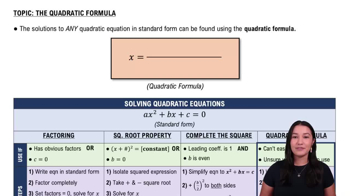
Quadratic Formula
Exact Values of Trigonometric Functions
Exact values refer to precise trigonometric ratios often derived from special angles such as π/3, π/2, etc. These values are expressed in simplified radical form or fractions, not decimals. Recognizing these angles and their sine or cosine values is essential for solving problems without approximation.
Recommended video:
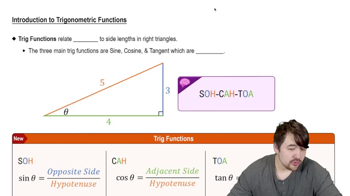
Introduction to Trigonometric Functions
Using Trigonometric Identities to Find Unknown Values
Identities like sin²θ + cos²θ = 1 allow calculation of unknown trigonometric values when one is given. This is crucial when the problem provides sine or cosine and requires finding the other function or related expressions, ensuring the solution respects the angle's quadrant.
Recommended video:
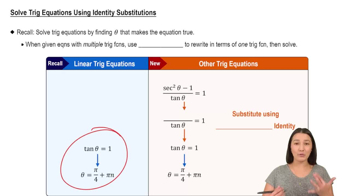
Solve Trig Equations Using Identity Substitutions
Related Practice
Textbook Question
Textbook Question
In Exercises 39–42, use double- and half-angle formulas to find the exact value of each expression. sin 22.5°
3
views
Textbook Question
In Exercises 35–38, find the exact value of the following under the given conditions:
e. cos(β/2)
sin α = 3/5, 0 < α < 𝝅/2, and sin β = 12/13, 𝝅/2 < β < 𝝅.
2
views
Textbook Question
In Exercises 35–38, find the exact value of the following under the given conditions:
b. cos(α﹣β)
sin α = -1/3, 𝝅 < α < 3𝝅/2, and cos β = -1/3, 𝝅 < β < 3𝝅/2.
1
views
Textbook Question
In Exercises 54–67, solve each equation on the interval [0, 2𝝅). Use exact values where possible or give approximate solutions correct to four decimal places. cos 2x = -1
5
views
Textbook Question
In Exercises 50–53, find all solutions of each equation. cos x = ﹣1/2