Ch. 3 - Trigonometric Identities and Equations
Blitzer - Trigonometry 3rd Edition
Blitzer3rd EditionTrigonometryISBN: 9780137316601Not the one you use?Change textbook
Chapter 3, Problem 15

Find all solutions of each equation. cos x = ﹣1/2

Verified step by step guidance
1
Recognize that the equation is \( \cos x = -\frac{1}{2} \). Our goal is to find all angles \( x \) where the cosine value is \( -\frac{1}{2} \).
Recall the unit circle values for cosine. Cosine corresponds to the x-coordinate on the unit circle. The value \( -\frac{1}{2} \) occurs at specific standard angles in the second and third quadrants.
Identify the reference angle \( \theta \) where \( \cos \theta = \frac{1}{2} \). This reference angle is \( \theta = \frac{\pi}{3} \) (or 60 degrees).
Since cosine is negative in the second and third quadrants, the solutions for \( x \) are \( x = \pi - \frac{\pi}{3} \) and \( x = \pi + \frac{\pi}{3} \).
Write the general solution by adding the full period of cosine, which is \( 2\pi \), to each solution: \( x = \pi \pm \frac{\pi}{3} + 2k\pi \), where \( k \) is any integer.

Verified video answer for a similar problem:

This video solution was recommended by our tutors as helpful for the problem above.
Video duration:
8m
Was this helpful?

Key Concepts

Here are the essential concepts you must grasp in order to answer the question correctly.

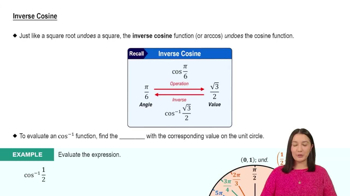
Inverse Cosine Function (Arccos)

The inverse cosine function, denoted as arccos or cos⁻¹, is used to find the angle whose cosine value is a given number. Since cosine is not one-to-one over all real numbers, arccos returns values in the principal range [0, π]. This concept helps determine the initial solution(s) for the equation cos x = -1/2.
Recommended video:
4:49
Inverse Cosine

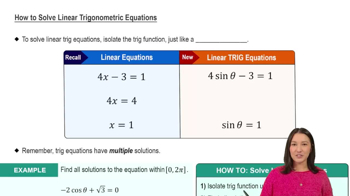
General Solutions of Trigonometric Equations

Trigonometric equations often have infinitely many solutions due to the periodic nature of trig functions. For cosine, solutions repeat every 2π. After finding the principal solution using arccos, the general solutions are given by x = ± arccos(value) + 2kπ, where k is any integer, capturing all possible angles.
Recommended video:
4:34
How to Solve Linear Trigonometric Equations

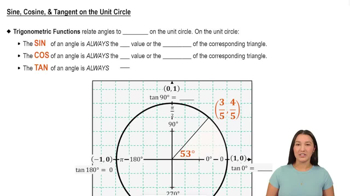
Unit Circle and Cosine Values

The unit circle represents angles and their cosine values as the x-coordinate of points on the circle. Understanding where cosine equals -1/2 on the unit circle (in the second and third quadrants) helps visualize and identify the specific angle measures that satisfy the equation cos x = -1/2.
Recommended video:
6:34
Sine, Cosine, & Tangent on the Unit Circle