Ch. 2 - Graphs of the Trigonometric Functions; Inverse Trigonometric Functions
Blitzer - Trigonometry 3rd Edition
Blitzer3rd EditionTrigonometryISBN: 9780137316601Not the one you use?Change textbook
Chapter 2, Problem 13

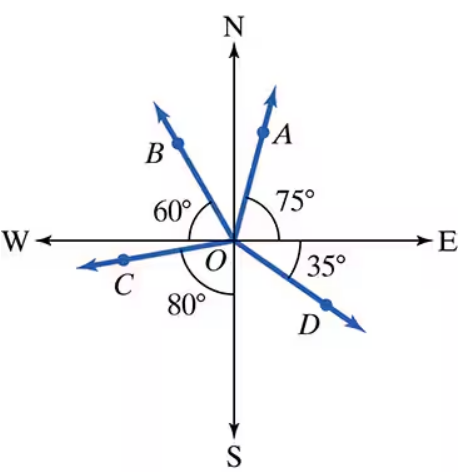
Find the bearing from O to A.

Verified step by step guidance
1
Identify the reference direction for bearings, which is always measured clockwise from the north (N) direction.
Locate point A on the diagram. Since the problem asks for the bearing from O to A, and the diagram shows points P, Q, R, and S, confirm if point A corresponds to one of these points or if it is missing from the image. If point A is not shown, clarify or check the problem statement again.
If point A corresponds to one of the points shown (for example, Q, R, P, or S), use the given angles to calculate the bearing. Bearings are measured clockwise from north, so start from the north line and move clockwise to the line pointing to the point.
For example, if point A corresponds to point Q, the bearing from O to Q is given directly as 61° clockwise from north.
If point A corresponds to another point, add or subtract the given angles accordingly to find the clockwise angle from north to the line pointing to A. This angle is the bearing from O to A.

Verified video answer for a similar problem:

This video solution was recommended by our tutors as helpful for the problem above.
Video duration:
2m
Was this helpful?

Key Concepts

Here are the essential concepts you must grasp in order to answer the question correctly.

Understanding Bearings

Bearings are a way to describe direction using degrees measured clockwise from the north line. They range from 0° to 360°, with north as 0° or 360°, east as 90°, south as 180°, and west as 270°. Bearings help in navigation and locating points relative to a reference direction.
Recommended video:
3:22
Example 2

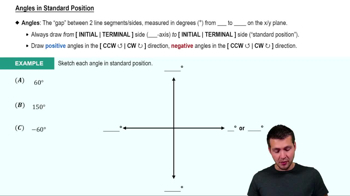
Using Angles in Standard Position

Angles in standard position are measured from the positive x-axis (east) counterclockwise. In navigation, angles are often given relative to north or south lines, so converting between these references is essential. Understanding how to add or subtract angles based on quadrant location is key to finding bearings.
Recommended video:
05:50
Drawing Angles in Standard Position

Interpreting Diagrams with Compass Directions

Diagrams with compass directions show points and angles relative to north, east, south, and west. Recognizing how angles relate to these directions allows you to calculate bearings accurately. For example, an angle given from the west line can be converted to a bearing by considering its position clockwise from north.
Recommended video:
05:13
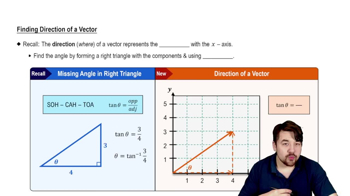
Finding Direction of a Vector