Ch. 2 - Graphs of the Trigonometric Functions; Inverse Trigonometric Functions
Blitzer - Trigonometry 3rd Edition
Blitzer3rd EditionTrigonometryISBN: 9780137316601Not the one you use?Change textbook
Chapter 2, Problem 11

Determine the amplitude, period, and phase shift of each function. Then graph one period of the function. y = −3 sin(π/3 x − 3π)

Verified step by step guidance
1
Identify the general form of the sine function: \(y = A \sin(Bx - C)\), where \(A\) is the amplitude, \(B\) affects the period, and \(C\) relates to the phase shift.
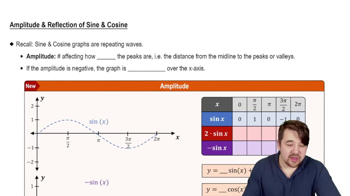
Find the amplitude by taking the absolute value of the coefficient in front of the sine function: \(\text{Amplitude} = |A| = |-3|\).
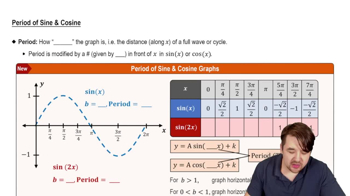
Calculate the period using the formula \(\text{Period} = \frac{2\pi}{|B|}\). Here, \(B\) is the coefficient of \(x\) inside the sine function, which is \(\frac{\pi}{3}\).
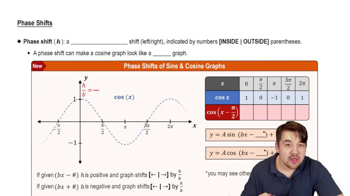
Determine the phase shift using the formula \(\text{Phase shift} = \frac{C}{B}\), where \(C\) is the constant subtracted inside the sine function (note the sign inside the parentheses). In this case, \(C = 3\pi\) and \(B = \frac{\pi}{3}\).
To graph one period of the function, start at the phase shift on the x-axis, then plot points at intervals of \(\frac{\text{Period}}{4}\) to capture key points of the sine wave (maximum, zero crossing, minimum, zero crossing), and use the amplitude to determine the y-values.

Verified video answer for a similar problem:

This video solution was recommended by our tutors as helpful for the problem above.
Video duration:
7m
Was this helpful?

Key Concepts

Here are the essential concepts you must grasp in order to answer the question correctly.

Amplitude of a Sine Function

Amplitude is the maximum absolute value of the sine function's output, representing the height from the midline to the peak. For y = a sin(bx + c), the amplitude is |a|. In this case, the amplitude is 3, indicating the graph oscillates 3 units above and below the midline.
Recommended video:
5:05
Amplitude and Reflection of Sine and Cosine

Period of a Sine Function

The period is the length of one complete cycle of the sine wave. It is calculated as (2π) divided by the absolute value of the coefficient b in y = a sin(bx + c). Here, with b = π/3, the period is 2π ÷ (π/3) = 6, meaning the function repeats every 6 units along the x-axis.
Recommended video:
5:33
Period of Sine and Cosine Functions

Phase Shift of a Sine Function

Phase shift is the horizontal translation of the sine graph, determined by solving bx + c = 0 for x. It equals -c/b, indicating how far the graph shifts left or right. For y = −3 sin(π/3 x − 3π), the phase shift is (3π) ÷ (π/3) = 9 units to the right.
Recommended video:
6:31
Phase Shifts