In Exercises 63–82, use a sketch to find the exact value of each expression. cot (csc⁻¹ 8)
Ch. 2 - Graphs of the Trigonometric Functions; Inverse Trigonometric Functions

All textbooks
Blitzer 3rd Edition
Ch. 2 - Graphs of the Trigonometric Functions; Inverse Trigonometric Functions
Problem 77
Blitzer 3rd Edition
Ch. 2 - Graphs of the Trigonometric Functions; Inverse Trigonometric Functions
Problem 77Chapter 2, Problem 77
In Exercises 63–82, use a sketch to find the exact value of each expression. cos [tan⁻¹ (− 2/3)]
Verified step by step guidance1
Recognize that the expression involves the cosine of an inverse tangent function: \(\cos\left(\tan^{-1}\left(-\frac{2}{3}\right)\right)\). This means we need to find the cosine of an angle whose tangent is \(-\frac{2}{3}\).
Let \(\theta = \tan^{-1}\left(-\frac{2}{3}\right)\). By definition, \(\tan(\theta) = -\frac{2}{3}\). We can think of \(\theta\) as an angle in a right triangle where the opposite side is \(-2\) and the adjacent side is \(3\) (the negative sign indicates direction, which affects the quadrant).
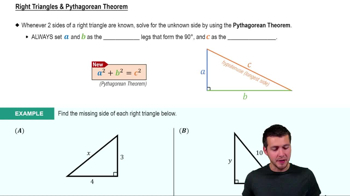
Use the Pythagorean theorem to find the hypotenuse \(r\) of the triangle: \(r = \sqrt{(3)^2 + (-2)^2} = \sqrt{9 + 4} = \sqrt{13}\).
Recall that \(\cos(\theta) = \frac{\text{adjacent}}{\text{hypotenuse}}\). Using the triangle sides, \(\cos(\theta) = \frac{3}{\sqrt{13}}\). Consider the sign of cosine based on the quadrant of \(\theta\) (since tangent is negative, \(\theta\) lies in either the second or fourth quadrant).
Determine the correct sign of \(\cos(\theta)\) based on the quadrant and write the exact value of \(\cos\left(\tan^{-1}\left(-\frac{2}{3}\right)\right)\) as \(\pm \frac{3}{\sqrt{13}}\) accordingly.

Verified video answer for a similar problem:
This video solution was recommended by our tutors as helpful for the problem above.
Video duration:
3mWas this helpful?
Key Concepts
Here are the essential concepts you must grasp in order to answer the question correctly.
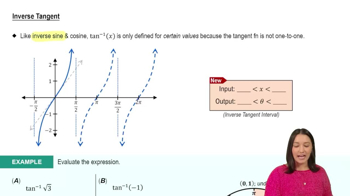
Inverse Tangent Function (tan⁻¹ or arctan)
The inverse tangent function returns the angle whose tangent is a given number. For tan⁻¹(−2/3), it gives an angle in the range of −π/2 to π/2 whose tangent is −2/3. Understanding this helps in interpreting the angle involved in the problem.
Recommended video:
Inverse Tangent
Right Triangle Representation of Trigonometric Ratios
Trigonometric functions can be represented using right triangles, where the sides correspond to ratios like opposite, adjacent, and hypotenuse. For tan⁻¹(−2/3), a triangle with opposite side −2 and adjacent side 3 can be sketched to find the hypotenuse and then calculate cosine.
Recommended video:
Solving Right Triangles with the Pythagorean Theorem
Relationship Between Tangent and Cosine
Cosine of an angle can be found using the sides of the right triangle: cos(θ) = adjacent/hypotenuse. Given tan(θ) = opposite/adjacent, once the hypotenuse is found using the Pythagorean theorem, cosine can be calculated exactly.
Recommended video:
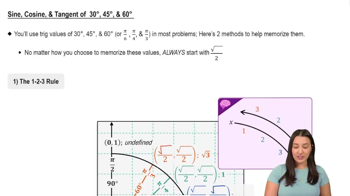
Sine, Cosine, & Tangent of 30°, 45°, & 60°
Related Practice
Textbook Question
Textbook Question
In Exercises 63–82, use a sketch to find the exact value of each expression. tan [cos⁻¹ (− 1/3)]
Textbook Question
In Exercises 79–82, graph f, g, and h in the same rectangular coordinate system for 0 ≤ x ≤ 2π. Obtain the graph of h by adding or subtracting the corresponding y-coordinates on the graphs of f and g. f(x) = 2 cos x, g(x) = cos 2x, h(x) = (f + g)(x)
Textbook Question
In Exercises 75–78, graph one period of each function. y = |2 cos x/2|
2
views
Textbook Question
In Exercises 79–82, graph f, g, and h in the same rectangular coordinate system for 0 ≤ x ≤ 2π. Obtain the graph of h by adding or subtracting the corresponding y-coordinates on the graphs of f and g. f(x) = cos x, g(x) = sin 2x, h(x) = (f − g)(x)
Textbook Question
In Exercises 75–78, graph one period of each function. y = −|3 sin πx|
4
views