Ch. 2 - Graphs of the Trigonometric Functions; Inverse Trigonometric Functions
Blitzer - Trigonometry 3rd Edition
Blitzer3rd EditionTrigonometryISBN: 9780137316601Not the one you use?Change textbook
Chapter 2, Problem 63

In Exercises 63–82, use a sketch to find the exact value of each expression. cos (sin⁻¹ 4/5)

Verified step by step guidance
1
Recognize that the expression is \( \cos(\sin^{-1}(\frac{4}{5})) \). Here, \( \sin^{-1}(\frac{4}{5}) \) represents an angle \( \theta \) whose sine is \( \frac{4}{5} \). So, let \( \theta = \sin^{-1}(\frac{4}{5}) \), which means \( \sin \theta = \frac{4}{5} \).
Draw a right triangle to represent the angle \( \theta \). Since \( \sin \theta = \frac{\text{opposite}}{\text{hypotenuse}} = \frac{4}{5} \), label the side opposite to \( \theta \) as 4 and the hypotenuse as 5.
Use the Pythagorean theorem to find the adjacent side of the triangle. The formula is \( \text{adjacent} = \sqrt{\text{hypotenuse}^2 - \text{opposite}^2} = \sqrt{5^2 - 4^2} \).
Calculate the adjacent side length (do not simplify fully here, just set up the expression). This gives \( \sqrt{25 - 16} = \sqrt{9} \).
Now, find \( \cos \theta \) using the triangle sides: \( \cos \theta = \frac{\text{adjacent}}{\text{hypotenuse}} = \frac{\sqrt{9}}{5} \). This expression represents the exact value of \( \cos(\sin^{-1}(\frac{4}{5})) \).

Verified video answer for a similar problem:

This video solution was recommended by our tutors as helpful for the problem above.
Video duration:
3m
Was this helpful?

Key Concepts

Here are the essential concepts you must grasp in order to answer the question correctly.

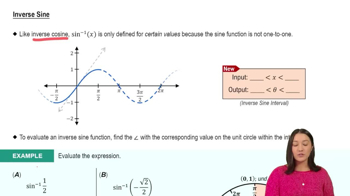
Inverse Sine Function (sin⁻¹ or arcsin)

The inverse sine function, sin⁻¹(x), returns the angle whose sine is x. It is defined for inputs between -1 and 1 and outputs angles in the range [-π/2, π/2]. Understanding this helps identify the angle corresponding to a given sine value.
Recommended video:
4:03
Inverse Sine

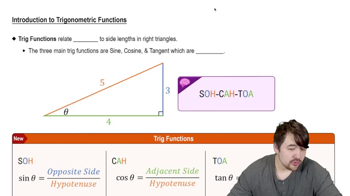
Right Triangle Interpretation of Trigonometric Functions

Trigonometric functions can be represented using right triangles, where sine is the ratio of the opposite side to the hypotenuse. Sketching a triangle with sin θ = 4/5 allows determination of other sides and angles, facilitating calculation of related trig values like cosine.
Recommended video:
6:04
Introduction to Trigonometric Functions

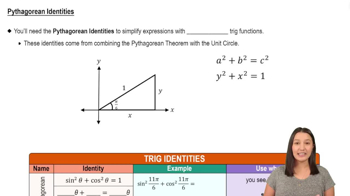
Pythagorean Identity

The Pythagorean identity states that sin²θ + cos²θ = 1 for any angle θ. This relationship allows calculation of cosine when sine is known by rearranging to cos θ = ±√(1 - sin²θ), with the sign determined by the angle's quadrant.
Recommended video:
6:25
Pythagorean Identities