In Exercises 63–82, use a sketch to find the exact value of each expression. tan [cos⁻¹ (− 1/3)]
Ch. 2 - Graphs of the Trigonometric Functions; Inverse Trigonometric Functions

All textbooks
Blitzer 3rd Edition
Ch. 2 - Graphs of the Trigonometric Functions; Inverse Trigonometric Functions
Problem 69
Blitzer 3rd Edition
Ch. 2 - Graphs of the Trigonometric Functions; Inverse Trigonometric Functions
Problem 69Chapter 2, Problem 69
In Exercises 63–82, use a sketch to find the exact value of each expression. _ sin (cos⁻¹ √2/2)
Verified step by step guidance1
Recognize that the expression is \( \sin(\cos^{-1}(\frac{\sqrt{2}}{2})) \). Here, \( \cos^{-1} \) is the inverse cosine function, which gives an angle \( \theta \) such that \( \cos \theta = \frac{\sqrt{2}}{2} \).
Let \( \theta = \cos^{-1}(\frac{\sqrt{2}}{2}) \). This means \( \cos \theta = \frac{\sqrt{2}}{2} \). Our goal is to find \( \sin \theta \).
Recall the Pythagorean identity: \( \sin^2 \theta + \cos^2 \theta = 1 \). Substitute \( \cos \theta = \frac{\sqrt{2}}{2} \) into the identity to find \( \sin^2 \theta \):
\[ \sin^2 \theta = 1 - \cos^2 \theta = 1 - \left( \frac{\sqrt{2}}{2} \right)^2 \]
Simplify the expression inside the square root to find \( \sin^2 \theta \), then take the square root to find \( \sin \theta \):
\[ \sin \theta = \pm \sqrt{1 - \left( \frac{\sqrt{2}}{2} \right)^2} \]
Determine the correct sign of \( \sin \theta \) by considering the range of \( \cos^{-1} \), which is \( [0, \pi] \). Since \( \theta \) is in the first or second quadrant, \( \sin \theta \) is non-negative in the first quadrant and positive in the second quadrant. Use this to select the positive or negative root.

Verified video answer for a similar problem:
This video solution was recommended by our tutors as helpful for the problem above.
Video duration:
3mWas this helpful?
Key Concepts
Here are the essential concepts you must grasp in order to answer the question correctly.
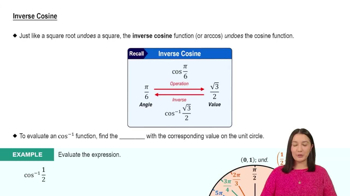
Inverse Cosine Function (cos⁻¹)
The inverse cosine function, cos⁻¹(x), returns the angle whose cosine is x, typically within the range 0 to π radians. It helps find an angle when the cosine value is known, which is essential for evaluating expressions like sin(cos⁻¹(x)).
Recommended video:
Inverse Cosine
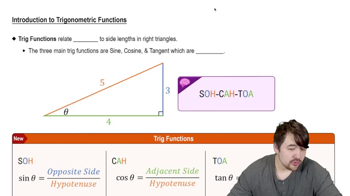
Right Triangle Interpretation of Trigonometric Functions
Trigonometric functions can be interpreted using right triangles, where cosine represents the adjacent side over hypotenuse. Using cos⁻¹(√2/2) gives an angle whose adjacent side and hypotenuse lengths can be used to find the opposite side, aiding in calculating sine of that angle.
Recommended video:
Introduction to Trigonometric Functions
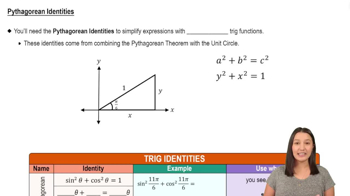
Pythagorean Identity
The Pythagorean identity states that sin²θ + cos²θ = 1 for any angle θ. This identity allows us to find sin(θ) when cos(θ) is known by rearranging to sin(θ) = √(1 - cos²θ), which is crucial for evaluating sin(cos⁻¹(√2/2)).
Recommended video:
Pythagorean Identities
Related Practice
Textbook Question
Textbook Question
In Exercises 67–68, use the method of adding y-coordinates to graph each function for 0 ≤ x ≤ 4. y = cos πx + sin π/2 x
Textbook Question
In Exercises 75–78, graph one period of each function. y = |2 cos x/2|
2
views
Textbook Question
In Exercises 63–82, use a sketch to find the exact value of each expression. tan [sin⁻¹ (− 3/5)]
6
views
Textbook Question
In Exercises 75–78, graph one period of each function. y = −|3 sin πx|
4
views
Textbook Question
In Exercises 67–68, an object is attached to a coiled spring. In Exercise 67, the object is pulled down (negative direction from the rest position) and then released. In Exercise 68, the object is propelled downward from its rest position. Write an equation for the distance of the object from its rest position after t seconds.
1
views