In Exercises 53–60, use a vertical shift to graph one period of the function. y = −3 sin 2πx + 2
Ch. 2 - Graphs of the Trigonometric Functions; Inverse Trigonometric Functions

All textbooks
Blitzer 3rd Edition
Ch. 2 - Graphs of the Trigonometric Functions; Inverse Trigonometric Functions
Problem 59
Blitzer 3rd Edition
Ch. 2 - Graphs of the Trigonometric Functions; Inverse Trigonometric Functions
Problem 59Chapter 2, Problem 59
In Exercises 55–62, use the properties of inverse functions f(f⁻¹ (x)) = x for all x in the domain of f⁻¹ and f⁻¹(f(x)) for all x in the domain of f, as well as the definitions of the inverse cotangent, cosecant, and secant functions, to find the exact value of each expression, if possible. cot⁻¹ (cot 3π/4)
Verified step by step guidance1
Recall the property of inverse functions: for any function \( f \) and its inverse \( f^{-1} \), \( f^{-1}(f(x)) = x \) holds true for all \( x \) in the domain of \( f \).
Identify the function and its inverse in the expression: here, \( \cot^{-1} \) is the inverse cotangent function, and \( \cot \) is the cotangent function.
Understand the domain and range of the inverse cotangent function: \( \cot^{-1}(x) \) typically returns values in the interval \( (0, \pi) \).
Since \( \cot^{-1}(\cot(\theta)) = \theta \) only if \( \theta \) is in the principal range of \( \cot^{-1} \), check if \( 3\pi/4 \) lies within \( (0, \pi) \).
Because \( 3\pi/4 \) is within \( (0, \pi) \), you can conclude that \( \cot^{-1}(\cot(3\pi/4)) = 3\pi/4 \).

Verified video answer for a similar problem:
This video solution was recommended by our tutors as helpful for the problem above.
Video duration:
1mWas this helpful?
Key Concepts
Here are the essential concepts you must grasp in order to answer the question correctly.
Inverse Trigonometric Functions
Inverse trigonometric functions reverse the effect of their corresponding trigonometric functions, returning an angle from a given ratio. For example, cot⁻¹(x) gives the angle whose cotangent is x. Understanding their domains and ranges is crucial to correctly evaluate expressions involving these inverses.
Recommended video:
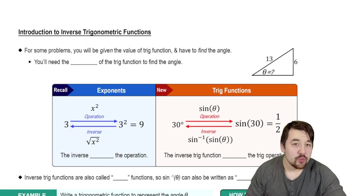
Introduction to Inverse Trig Functions
Properties of Inverse Functions
The key property f(f⁻¹(x)) = x holds for all x in the domain of f⁻¹, and f⁻¹(f(x)) = x for all x in the domain of f. This means applying a function and its inverse in succession returns the original input, but only when the input lies within the appropriate domain or range.
Recommended video:
Introduction to Inverse Trig Functions
Principal Values and Domain Restrictions
Inverse trigonometric functions have restricted ranges (principal values) to ensure they are functions. For cot⁻¹(x), the principal value range is typically (0, π). When evaluating cot⁻¹(cot θ), the result is the principal value angle equivalent to θ within this range, not necessarily θ itself.
Recommended video:
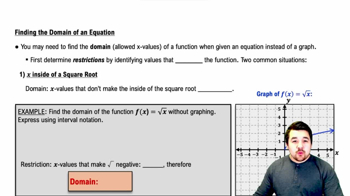
Finding the Domain of an Equation
Related Practice
Textbook Question
Textbook Question
In Exercises 53–60, use a vertical shift to graph one period of the function. y = cos x + 3
4
views
Textbook Question
In Exercises 61–62, use the figures shown to find the bearing from O to A.
9
views
Textbook Question
In Exercises 61–66, use the method of adding y-coordinates to graph each function for 0 ≤ x ≤ 2π. y = 3 cos x + sin x
2
views
Textbook Question
In Exercises 55–62, use the properties of inverse functions f(f⁻¹ (x)) = x for all x in the domain of f⁻¹ and f⁻¹(f(x)) for all x in the domain of f, as well as the definitions of the inverse cotangent, cosecant, and secant functions, to find the exact value of each expression, if possible. sec(sec⁻¹ 7π)
Textbook Question
In Exercises 55–58, use a graph to solve each equation for -2π ≤ x ≤ 2π. csc x = 1
1
views