Ch. 2 - Graphs of the Trigonometric Functions; Inverse Trigonometric Functions
Blitzer - Trigonometry 3rd Edition
Blitzer3rd EditionTrigonometryISBN: 9780137316601Not the one you use?Change textbook
Chapter 2, Problem 55

In Exercises 55–62, use the properties of inverse functions f(f⁻¹ (x)) = x for all x in the domain of f⁻¹ and f⁻¹(f(x)) for all x in the domain of f, as well as the definitions of the inverse cotangent, cosecant, and secant functions, to find the exact value of each expression, if possible. cot(cot⁻¹ 9π)

Verified step by step guidance
1
Recall the property of inverse functions: for any function \( f \) and its inverse \( f^{-1} \), \( f(f^{-1}(x)) = x \) for all \( x \) in the domain of \( f^{-1} \).
Identify the function and its inverse in the expression: here, \( f = \cot \) and \( f^{-1} = \cot^{-1} \), so the expression \( \cot(\cot^{-1}(9\pi)) \) fits the form \( f(f^{-1}(x)) \).
Check the domain of the inverse cotangent function \( \cot^{-1} \). The principal value of \( \cot^{-1}(x) \) is usually defined to be in the interval \( (0, \pi) \). Since \( 9\pi \) is a positive number, \( \cot^{-1}(9\pi) \) is within the domain of \( \cot \).
Apply the inverse function property: \( \cot(\cot^{-1}(9\pi)) = 9\pi \), because the output of \( \cot^{-1}(9\pi) \) is an angle whose cotangent is \( 9\pi \).
Therefore, the exact value of the expression \( \cot(\cot^{-1}(9\pi)) \) is \( 9\pi \).

Verified video answer for a similar problem:

This video solution was recommended by our tutors as helpful for the problem above.
Video duration:
1m
Was this helpful?

Key Concepts

Here are the essential concepts you must grasp in order to answer the question correctly.

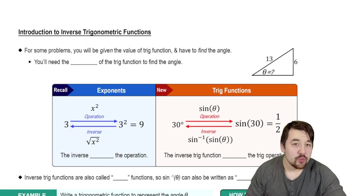
Inverse Trigonometric Functions

Inverse trigonometric functions reverse the effect of their corresponding trigonometric functions, returning an angle when given a ratio. For example, cot⁻¹(x) gives the angle whose cotangent is x. Understanding their domains and ranges is essential to correctly evaluate expressions involving these functions.
Recommended video:
4:28
Introduction to Inverse Trig Functions

Properties of Inverse Functions

The key property f(f⁻¹(x)) = x holds for all x in the domain of f⁻¹, meaning applying a function and its inverse in succession returns the original input. Similarly, f⁻¹(f(x)) = x for all x in the domain of f. This property helps simplify expressions like cot(cot⁻¹(9π)) to 9π, provided the value lies within the appropriate domain.
Recommended video:
4:28
Introduction to Inverse Trig Functions

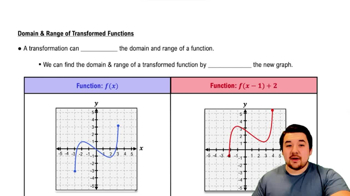
Domain and Range Restrictions of Cotangent and Its Inverse

The cotangent function is not one-to-one over all real numbers, so its inverse cot⁻¹ is defined with a restricted range, typically (0, π). This restriction ensures the inverse is a function. When evaluating cot(cot⁻¹(x)), the result equals x only if x is within the range of cot on (0, π), otherwise adjustments or interpretations are needed.
Recommended video:
4:22
Domain and Range of Function Transformations