Ch. 2 - Graphs of the Trigonometric Functions; Inverse Trigonometric Functions
Blitzer - Trigonometry 3rd Edition
Blitzer3rd EditionTrigonometryISBN: 9780137316601Not the one you use?Change textbook
Chapter 2, Problem 51

In Exercises 29–51, find the exact value of each expression. Do not use a calculator. sin⁻¹(cos 2π/3)

Verified step by step guidance
1
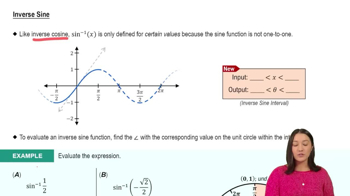
Recall that the function \( \sin^{-1}(x) \) (also called arcsine) gives the angle \( \theta \) in the range \( \left[-\frac{\pi}{2}, \frac{\pi}{2}\right] \) such that \( \sin(\theta) = x \).
First, evaluate \( \cos \frac{2\pi}{3} \). Use the unit circle or cosine properties to find the exact value of \( \cos \frac{2\pi}{3} \).
Once you have \( \cos \frac{2\pi}{3} = x \), rewrite the original expression as \( \sin^{-1}(x) \).
Next, find the angle \( \theta \) in the interval \( \left[-\frac{\pi}{2}, \frac{\pi}{2}\right] \) such that \( \sin(\theta) = x \). This may involve using the identity \( \sin(\theta) = \sin(\pi - \theta) \) or considering the symmetry of sine and cosine functions.
Express the final answer as the exact angle \( \theta \) in radians that satisfies the above conditions, without using a calculator.

Verified video answer for a similar problem:

This video solution was recommended by our tutors as helpful for the problem above.
Video duration:
2m
Was this helpful?

Key Concepts

Here are the essential concepts you must grasp in order to answer the question correctly.

Inverse Sine Function (sin⁻¹ or arcsin)

The inverse sine function, sin⁻¹(x), returns the angle whose sine is x, with a principal range of [-π/2, π/2]. It is used to find angles from known sine values, and understanding its range is crucial to correctly interpreting results.
Recommended video:
4:03
Inverse Sine

Evaluating Cosine at Special Angles

Cosine values at special angles like 2π/3 are well-known and can be found using the unit circle. For 2π/3, cos(2π/3) equals -1/2. Recognizing these values helps simplify expressions before applying inverse trigonometric functions.
Recommended video:
3:48
Evaluate Composite Functions - Special Cases

Relationship Between Trigonometric Functions and Their Inverses

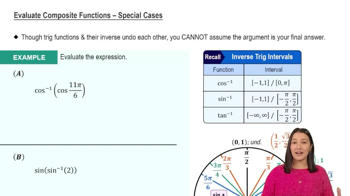
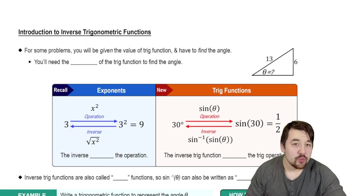
When evaluating expressions like sin⁻¹(cos θ), it is important to understand how the cosine value fits within the domain and range of the inverse sine function. This often involves converting cosine values to sine values or considering angle identities to find the correct angle.
Recommended video:
4:28
Introduction to Inverse Trig Functions