Ch. 2 - Graphs of the Trigonometric Functions; Inverse Trigonometric Functions
Blitzer - Trigonometry 3rd Edition
Blitzer3rd EditionTrigonometryISBN: 9780137316601Not the one you use?Change textbook
Chapter 2, Problem 47

In Exercises 29–51, find the exact value of each expression. Do not use a calculator. tan [cos⁻¹ (− 4/5)]

Verified step by step guidance
1
Recognize that the expression is \( \tan(\cos^{-1}(-\frac{4}{5})) \). Here, \( \cos^{-1}(-\frac{4}{5}) \) represents an angle \( \theta \) whose cosine is \( -\frac{4}{5} \). So, set \( \theta = \cos^{-1}(-\frac{4}{5}) \), which means \( \cos \theta = -\frac{4}{5} \).
Recall the Pythagorean identity: \( \sin^2 \theta + \cos^2 \theta = 1 \). Use this to find \( \sin \theta \) by substituting \( \cos \theta = -\frac{4}{5} \): \[ \sin^2 \theta = 1 - \cos^2 \theta = 1 - \left(-\frac{4}{5}\right)^2 = 1 - \frac{16}{25} = \frac{9}{25} \] Then, \( \sin \theta = \pm \frac{3}{5} \).
Determine the correct sign of \( \sin \theta \) by considering the range of \( \theta = \cos^{-1}(-\frac{4}{5}) \). Since \( \cos \theta \) is negative, \( \theta \) lies in the second quadrant where sine is positive. Therefore, \( \sin \theta = \frac{3}{5} \).
Use the definition of tangent in terms of sine and cosine: \[ \tan \theta = \frac{\sin \theta}{\cos \theta} = \frac{\frac{3}{5}}{-\frac{4}{5}} \]
Simplify the fraction by dividing the numerators and denominators: \[ \tan \theta = \frac{3}{5} \times \frac{5}{-4} = -\frac{3}{4} \] This gives the exact value of the original expression.

Verified video answer for a similar problem:

This video solution was recommended by our tutors as helpful for the problem above.
Video duration:
3m
Was this helpful?

Key Concepts

Here are the essential concepts you must grasp in order to answer the question correctly.

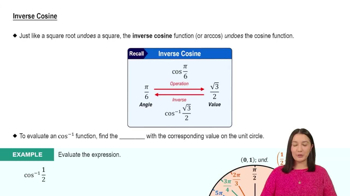
Inverse Cosine Function (cos⁻¹)

The inverse cosine function, cos⁻¹(x), returns the angle whose cosine is x. It produces an angle in the range [0, π], allowing us to find an angle given its cosine value. Understanding this helps in determining the reference angle for further trigonometric calculations.
Recommended video:
4:49
Inverse Cosine

Right Triangle Trigonometry

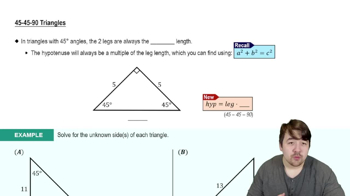
By interpreting the cosine value as the ratio of adjacent side over hypotenuse in a right triangle, we can find the lengths of the other sides. This approach allows us to use the Pythagorean theorem to find the opposite side, which is essential for calculating other trigonometric functions like tangent.
Recommended video:
04:39
45-45-90 Triangles

Tangent Function and Sign Determination

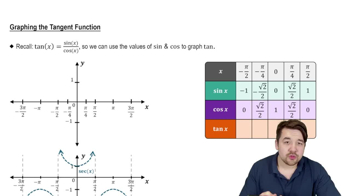
Tangent is the ratio of the opposite side to the adjacent side of an angle. After finding the sides, we calculate tan(θ) = opposite/adjacent. Additionally, knowing the quadrant of the angle (from the inverse cosine value) helps determine the correct sign of the tangent.
Recommended video:
5:43
Introduction to Tangent Graph