Textbook Question
In Exercises 29–51, find the exact value of each expression. Do not use a calculator. tan[sin⁻¹ (− 1/2)]
2
views

 Blitzer 3rd EditionCh. 2 - Graphs of the Trigonometric Functions; Inverse Trigonometric FunctionsProblem 43
 Verified step by step guidance
 6:22
6:22
 6:31
6:31 6:02
6:02In Exercises 29–51, find the exact value of each expression. Do not use a calculator. tan[sin⁻¹ (− 1/2)]
In Exercises 39–54, find the exact value of each expression, if possible. Do not use a calculator. sin⁻¹ (sin 5π/6)
In Exercises 29–51, find the exact value of each expression. Do not use a calculator. _ csc(tan⁻¹ √3/3)
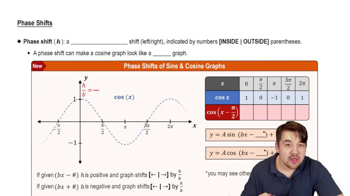
In Exercises 43–52, determine the amplitude, period, and phase shift of each function. Then graph one period of the function. y = cos(x − π/2)
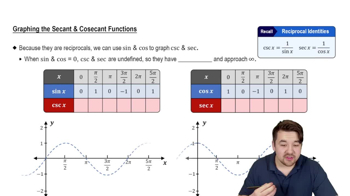
In Exercises 29–44, graph two periods of the given cosecant or secant function. y = csc(x − π)
In Exercises 37–40, an object moves in simple harmonic motion described by the given equation, where t is measured in seconds and d in inches. In each exercise, graph one period of the equation. Then find the following: a. the maximum displacement b. the frequency c. the time required for one cycle d. the phase shift of the motion. d = − 1/2 sin(πt/4 − π/2)