Ch. 2 - Graphs of the Trigonometric Functions; Inverse Trigonometric Functions
Blitzer - Trigonometry 3rd Edition
Blitzer3rd EditionTrigonometryISBN: 9780137316601Not the one you use?Change textbook
Chapter 2, Problem 7

Find the exact value of each expression. cos⁻¹ √3/2

Verified step by step guidance
1
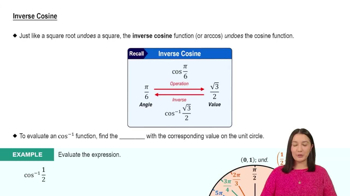
Recognize that the expression involves the inverse cosine function, written as \(\cos^{-1}\), which means we are looking for an angle whose cosine value is given.
Identify the value inside the inverse cosine function: \(\sqrt{3}/2\). Recall that \(\sqrt{3}/2\) is a common cosine value for special angles in the unit circle.
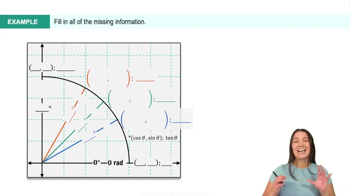
Recall the unit circle values for cosine: \(\cos 30^\circ = \cos \frac{\pi}{6} = \sqrt{3}/2\). This means the angle we are looking for is \(\frac{\pi}{6}\) radians (or 30 degrees).
Since the range of \(\cos^{-1}\) is \([0, \pi]\), the principal value of \(\cos^{-1} \left( \sqrt{3}/2 \right)\) is \(\frac{\pi}{6}\).
Therefore, the exact value of \(\cos^{-1} \left( \sqrt{3}/2 \right)\) is the angle \(\frac{\pi}{6}\) radians.

Verified video answer for a similar problem:

This video solution was recommended by our tutors as helpful for the problem above.
Video duration:
4m
Was this helpful?

Key Concepts

Here are the essential concepts you must grasp in order to answer the question correctly.

Inverse Cosine Function (cos⁻¹ or arccos)

The inverse cosine function, denoted as cos⁻¹ or arccos, returns the angle whose cosine value is a given number. It is defined for inputs between -1 and 1 and outputs angles in the range 0 to π radians (0° to 180°). Understanding this function is essential to find the angle corresponding to a specific cosine value.
Recommended video:
4:49
Inverse Cosine

Exact Values of Cosine for Special Angles

Certain angles have well-known cosine values expressed in exact radical form, such as cos(30°) = √3/2. Recognizing these special angles allows you to determine the exact angle from a given cosine value without using a calculator, which is crucial for solving inverse trigonometric problems.
Recommended video:
6:04
Example 1

Domain and Range Restrictions of Inverse Trigonometric Functions

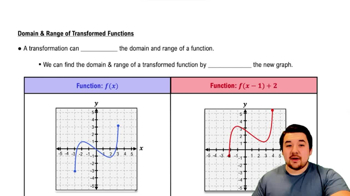
Inverse trigonometric functions have specific domain and range restrictions to ensure they are functions. For arccos, the input must be between -1 and 1, and the output angle lies between 0 and π radians. Knowing these restrictions helps identify the correct angle solution when evaluating inverse cosine expressions.
Recommended video:
4:22
Domain and Range of Function Transformations