Ch. 1 - Angles and the Trigonometric Functions
Blitzer - Trigonometry 3rd Edition
Blitzer3rd EditionTrigonometryISBN: 9780137316601Not the one you use?Change textbook
Chapter 1, Problem 95

Let f(x) = sin x, g(x) = cos x, and h(x) = 2x. Find the exact value of each expression. Do not use a calculator. (h o g) (17๐œ‹/3)

Verified step by step guidance
1
Understand that the notation \( (h \circ g)(x) \) means the composition of functions \( h \) and \( g \), which is \( h(g(x)) \). So, you first apply \( g \) to \( x \), then apply \( h \) to the result.
Identify the given functions: \( g(x) = \cos x \) and \( h(x) = 2x \). Therefore, \( (h \circ g)(x) = h(g(x)) = 2 \cdot g(x) = 2 \cos x \).
Substitute \( x = \frac{17\pi}{3} \) into the expression: \( (h \circ g)\left( \frac{17\pi}{3} \right) = 2 \cos \left( \frac{17\pi}{3} \right) \).
Simplify the angle \( \frac{17\pi}{3} \) by reducing it within the standard interval \( [0, 2\pi) \) using the periodicity of cosine, which has period \( 2\pi \). Calculate \( \frac{17\pi}{3} - 2\pi \times n \) for an integer \( n \) to find an equivalent angle between 0 and \( 2\pi \).
Evaluate \( \cos \) of the simplified angle using known exact values of cosine for standard angles, then multiply the result by 2 to find \( (h \circ g)\left( \frac{17\pi}{3} \right) \).

Verified video answer for a similar problem:

This video solution was recommended by our tutors as helpful for the problem above.
Video duration:
4m
Was this helpful?

Key Concepts

Here are the essential concepts you must grasp in order to answer the question correctly.

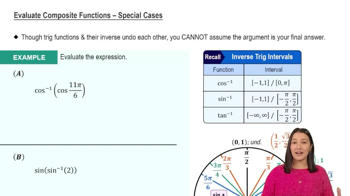
Function Composition

Function composition involves applying one function to the result of another, denoted as (f o g)(x) = f(g(x)). In this problem, (h o g)(x) means you first evaluate g(x), then use that output as the input for h. Understanding this process is essential to correctly evaluate the expression.
Recommended video:
3:48
Evaluate Composite Functions - Special Cases

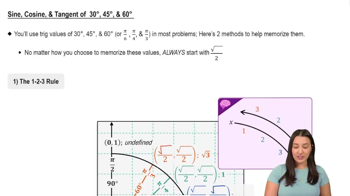
Trigonometric Values of Cosine

The function g(x) = cos x requires knowledge of cosine values at specific angles. Since the input is 17ฯ€/3, recognizing how to simplify angles using periodicity (cosine has period 2ฯ€) helps find an exact value without a calculator.
Recommended video:
5:08
Sine, Cosine, & Tangent of 30ยฐ, 45ยฐ, & 60ยฐ

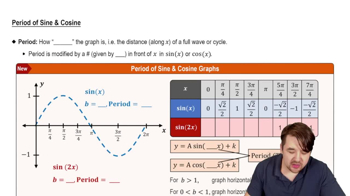
Periodicity and Angle Reduction

Trigonometric functions repeat their values in regular intervals called periods. For cosine, the period is 2ฯ€, so angles can be reduced by subtracting multiples of 2ฯ€ to find equivalent angles within one cycle. This simplification is key to evaluating trigonometric expressions exactly.
Recommended video:
5:33
Period of Sine and Cosine Functions