Ch. 1 - Angles and the Trigonometric Functions
Blitzer - Trigonometry 3rd Edition
Blitzer3rd EditionTrigonometryISBN: 9780137316601Not the one you use?Change textbook
Chapter 1, Problem 11

In Exercises 8–13, find the exact value of each expression. Do not use a calculator. sec 22πœ‹ 3

Verified step by step guidance
1
Recognize that the expression is \(\sec \left( \frac{22\pi}{3} \right)\), which involves the secant function of an angle measured in radians.
Recall that the secant function is the reciprocal of the cosine function, so \(\sec \theta = \frac{1}{\cos \theta}\). Therefore, finding \(\sec \left( \frac{22\pi}{3} \right)\) is equivalent to finding \(\frac{1}{\cos \left( \frac{22\pi}{3} \right)}\).
Since the cosine function is periodic with period \(2\pi\), reduce the angle \(\frac{22\pi}{3}\) by subtracting multiples of \(2\pi\) until the angle lies within the standard interval \([0, 2\pi)\): calculate \(\frac{22\pi}{3} - 2\pi \times k\) for an integer \(k\) such that the result is between \(0\) and \(2\pi\).
Once the angle is reduced to an equivalent angle \(\theta_{reduced}\) in \([0, 2\pi)\), evaluate \(\cos \theta_{reduced}\) using known values or unit circle properties.
Finally, compute \(\sec \left( \frac{22\pi}{3} \right) = \frac{1}{\cos \theta_{reduced}}\) to find the exact value.

Verified video answer for a similar problem:

This video solution was recommended by our tutors as helpful for the problem above.
Video duration:
6m
Was this helpful?

Key Concepts

Here are the essential concepts you must grasp in order to answer the question correctly.

Understanding the Secant Function

The secant function, sec(ΞΈ), is the reciprocal of the cosine function, defined as sec(ΞΈ) = 1/cos(ΞΈ). To find sec(ΞΈ), you first determine cos(ΞΈ) and then take its reciprocal. This relationship is fundamental when evaluating trigonometric expressions without a calculator.
Recommended video:
6:22
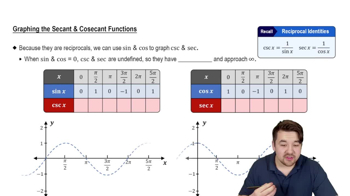
Graphs of Secant and Cosecant Functions

Evaluating Trigonometric Functions at Special Angles

Angles like 2Ο€/3 are special angles on the unit circle with known sine and cosine values. Recognizing these angles allows you to find exact trigonometric values using the unit circle, avoiding decimal approximations. For 2Ο€/3, cosine is negative one-half, which is key to finding sec(2Ο€/3).
Recommended video:
3:48
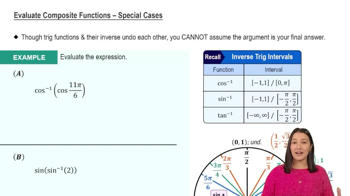
Evaluate Composite Functions - Special Cases

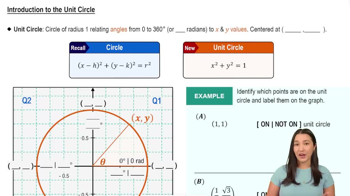
Using the Unit Circle for Exact Values

The unit circle provides exact values for sine and cosine at various angles measured in radians. By locating the angle 2Ο€/3 on the unit circle, you can identify the coordinates (cosine, sine) and thus find exact trigonometric values. This method is essential for solving problems without calculators.
Recommended video:
06:11
Introduction to the Unit Circle