Ch. 1 - Angles and the Trigonometric Functions
Blitzer - Trigonometry 3rd Edition
Blitzer3rd EditionTrigonometryISBN: 9780137316601Not the one you use?Change textbook
Chapter 1, Problem 1.RE.52

In Exercises 49–59, find the exact value of each expression. Do not use a calculator. cos (11πœ‹ / 6)

Verified step by step guidance
1
Recognize that the angle given is in radians: \(\frac{11\pi}{6}\). Since \(2\pi\) radians correspond to a full circle, we can use the periodicity of cosine to simplify the angle.
Use the periodic property of cosine: \(\cos(\theta) = \cos(\theta + 2k\pi)\) for any integer \(k\). Subtract \(2\pi\) from \(\frac{11\pi}{6}\) to find a coterminal angle within \([0, 2\pi)\).
Calculate the coterminal angle: \(\frac{11\pi}{6} - 2\pi = \frac{11\pi}{6} - \frac{12\pi}{6} = -\frac{\pi}{6}\). Since cosine is an even function, \(\cos(-\theta) = \cos(\theta)\), so \(\cos\left(-\frac{\pi}{6}\right) = \cos\left(\frac{\pi}{6}\right)\).
Recall the exact value of \(\cos\left(\frac{\pi}{6}\right)\) from the unit circle or special triangles: \(\cos\left(\frac{\pi}{6}\right) = \frac{\sqrt{3}}{2}\).
Therefore, the exact value of \(\cos\left(\frac{11\pi}{6}\right)\) is the same as \(\cos\left(\frac{\pi}{6}\right)\), which is \(\frac{\sqrt{3}}{2}\).

Verified video answer for a similar problem:

This video solution was recommended by our tutors as helpful for the problem above.
Video duration:
4m
Was this helpful?

Key Concepts

Here are the essential concepts you must grasp in order to answer the question correctly.

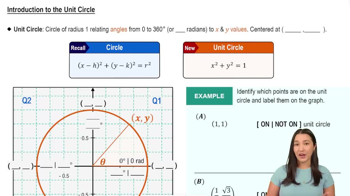
Unit Circle and Radian Measure

The unit circle is a circle with radius 1 centered at the origin, used to define trigonometric functions for all angles. Radian measure relates the angle to the length of the arc on the unit circle, where 2Ο€ radians equal 360Β°. Understanding how to locate angles like 11Ο€/6 on the unit circle is essential for evaluating trigonometric functions exactly.
Recommended video:
06:11
Introduction to the Unit Circle

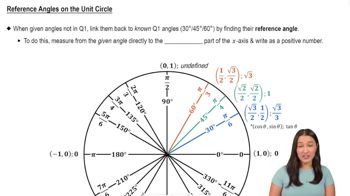
Reference Angles

A reference angle is the acute angle formed between the terminal side of a given angle and the x-axis. It helps simplify the evaluation of trigonometric functions by relating them to known values in the first quadrant. For angles greater than 2Ο€ or in other quadrants, finding the reference angle allows use of standard trigonometric values.
Recommended video:
5:31
Reference Angles on the Unit Circle

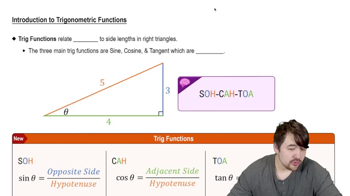
Exact Values of Trigonometric Functions

Certain angles on the unit circle correspond to exact trigonometric values expressed in terms of square roots and fractions, such as Ο€/6, Ο€/4, and Ο€/3. Knowing these exact values allows one to find cosine or sine without a calculator. For example, cos(Ο€/6) = √3/2, which can be used with reference angles to find cos(11Ο€/6).
Recommended video:
6:04
Introduction to Trigonometric Functions