Ch. 1 - Angles and the Trigonometric Functions
Blitzer - Trigonometry 3rd Edition
Blitzer3rd EditionTrigonometryISBN: 9780137316601Not the one you use?Change textbook
Chapter 1, Problem 1.RE.54

In Exercises 49–59, find the exact value of each expression. Do not use a calculator. csc(-2𝜋/3)

Verified step by step guidance
1
Recall the definition of cosecant: \(\csc \theta = \frac{1}{\sin \theta}\).
Use the property of sine for negative angles: \(\sin(-\theta) = -\sin \theta\). So, \(\sin\left(-\frac{2\pi}{3}\right) = -\sin\left(\frac{2\pi}{3}\right)\).
Find \(\sin\left(\frac{2\pi}{3}\right)\) by recognizing that \(\frac{2\pi}{3}\) is in the second quadrant where sine is positive, and it corresponds to \(\pi - \frac{\pi}{3} = \frac{2\pi}{3}\). So, \(\sin\left(\frac{2\pi}{3}\right) = \sin\left(\frac{\pi}{3}\right)\).
Recall the exact value \(\sin\left(\frac{\pi}{3}\right) = \frac{\sqrt{3}}{2}\), so \(\sin\left(\frac{2\pi}{3}\right) = \frac{\sqrt{3}}{2}\).
Combine these results to find \(\csc\left(-\frac{2\pi}{3}\right) = \frac{1}{\sin\left(-\frac{2\pi}{3}\right)} = \frac{1}{-\sin\left(\frac{2\pi}{3}\right)} = \frac{1}{-\frac{\sqrt{3}}{2}}\).

Verified video answer for a similar problem:

This video solution was recommended by our tutors as helpful for the problem above.
Video duration:
5m
Was this helpful?

Key Concepts

Here are the essential concepts you must grasp in order to answer the question correctly.

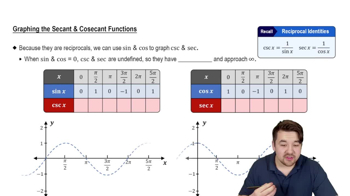
Understanding the Cosecant Function

Cosecant (csc) is the reciprocal of the sine function, defined as csc(θ) = 1/sin(θ). To find csc(θ), you first determine sin(θ) and then take its reciprocal. This relationship is fundamental when evaluating trigonometric expressions without a calculator.
Recommended video:
6:22
Graphs of Secant and Cosecant Functions

Evaluating Trigonometric Functions at Negative Angles

Trigonometric functions have specific properties for negative angles. For sine, sin(-θ) = -sin(θ), meaning the sine function is odd. This helps simplify expressions like csc(-2π/3) by relating them to positive angle values.
Recommended video:
7:28
Evaluate Composite Functions - Values Not on Unit Circle

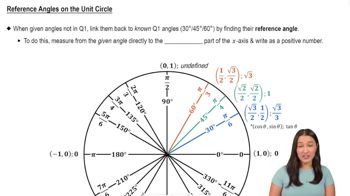
Reference Angles and Unit Circle Values

Using the unit circle, angles are measured in radians, and their sine values correspond to y-coordinates. The reference angle for 2π/3 is π/3, whose sine value is √3/2. Understanding reference angles allows exact evaluation of trigonometric functions at various angles.
Recommended video:
5:31
Reference Angles on the Unit Circle