Ch. 1 - Angles and the Trigonometric Functions
Blitzer - Trigonometry 3rd Edition
Blitzer3rd EditionTrigonometryISBN: 9780137316601Not the one you use?Change textbook
Chapter 1, Problem 25

In Exercises 25–30, use an identity to find the value of each expression. Do not use a calculator.sin 37° csc 37°

Verified step by step guidance
1
Recognize that \( \csc \theta \) is the reciprocal of \( \sin \theta \), which means \( \csc \theta = \frac{1}{\sin \theta} \).
Substitute \( \csc 37^\circ \) with \( \frac{1}{\sin 37^\circ} \) in the expression \( \sin 37^\circ \cdot \csc 37^\circ \).
The expression becomes \( \sin 37^\circ \cdot \frac{1}{\sin 37^\circ} \).
Simplify the expression by canceling \( \sin 37^\circ \) in the numerator and the denominator.
Conclude that the simplified expression equals 1.

Verified video answer for a similar problem:

This video solution was recommended by our tutors as helpful for the problem above.
Video duration:
2m
Was this helpful?

Key Concepts

Here are the essential concepts you must grasp in order to answer the question correctly.

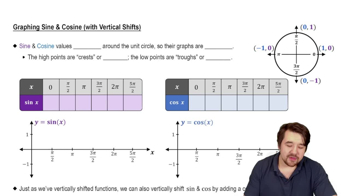
Sine Function

The sine function, denoted as sin(θ), is a fundamental trigonometric function that relates the angle θ of a right triangle to the ratio of the length of the opposite side to the hypotenuse. For example, sin(37°) represents this ratio for a triangle with a 37-degree angle.
Recommended video:
5:53
Graph of Sine and Cosine Function

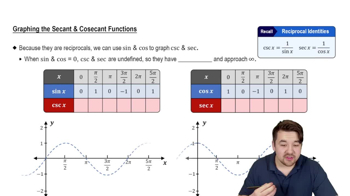
Cosecant Function

The cosecant function, denoted as csc(θ), is the reciprocal of the sine function. It is defined as csc(θ) = 1/sin(θ). Therefore, csc(37°) is equal to the reciprocal of sin(37°), which means it represents the ratio of the hypotenuse to the opposite side in a right triangle.
Recommended video:
6:22
Graphs of Secant and Cosecant Functions

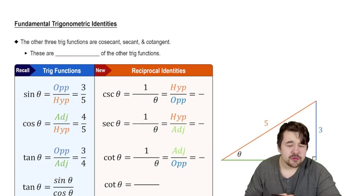
Trigonometric Identities

Trigonometric identities are equations that involve trigonometric functions and are true for all values of the variables involved. In this case, using the identity sin(θ) * csc(θ) = 1 can simplify the expression sin(37°) csc(37°) to 1, illustrating the relationship between sine and cosecant.
Recommended video:
5:32
Fundamental Trigonometric Identities
Related Practice
Textbook Question
In Exercises 25–32, the unit circle has been divided into eight equal arcs, corresponding to t-values of0, 𝜋, 𝜋, 3𝜋, 𝜋, 5𝜋, 3𝜋, 7𝜋, and 2𝜋.4 2 4 4 2 4 a. Use the (x,y) coordinates in the figure to find the value of the trigonometric function.b. Use periodic properties and your answer from part (a) to find the value of the same trigonometric function at the indicated real number.

sin 11𝜋/4
Textbook Question

In Exercises 21–28, convert each angle in radians to degrees. -3𝜋

4
views
Textbook Question

In Exercises 23–34, find the exact value of each of the remaining trigonometric functions of θ. cos θ = 8/17, 270° < θ < 360°

6
views
Textbook Question

In Exercises 25–32, the unit circle has been divided into eight equal arcs, corresponding to t-values of


0, 𝜋, 𝜋, 3𝜋, 𝜋, 5𝜋, 3𝜋, 7𝜋, and 2𝜋.

4 2 4 4 2 4


a. Use the (x,y) coordinates in the figure to find the value of the trigonometric function.

cos 3𝜋/4

3
views
Textbook Question
In Exercises 19–24, a. Use the unit circle shown for Exercises 5–18 to find the value of the trigonometric function.b. Use even and odd properties of trigonometric functions and your answer from part (a) to find the value of the same trigonometric function at the indicated real number.tan 5𝜋/3

Textbook Question
In Exercises 19–24, a. Use the unit circle shown for Exercises 5–18 to find the value of the trigonometric function.b. Use even and odd properties of trigonometric functions and your answer from part (a) to find the value of the same trigonometric function at the indicated real number.tan (-11𝜋/6)