Ch. 1 - Angles and the Trigonometric Functions
Blitzer - Trigonometry 3rd Edition
Blitzer3rd EditionTrigonometryISBN: 9780137316601Not the one you use?Change textbook
Chapter 1, Problem 14

In Exercises 13–17, find a positive angle less than 360° or 2𝜋 that is coterminal with the given angle. -445°

Verified step by step guidance
1
Understand that two angles are coterminal if they differ by a full rotation, which is 360° in degrees or \(2\pi\) in radians.
Since the given angle is \(-445^\circ\), we want to find a positive angle \(\theta\) such that \(\theta = -445^\circ + 360^\circ \times k\), where \(k\) is an integer.
Choose an integer \(k\) that makes \(\theta\) positive and less than 360°. Start by adding 360° once: \(-445^\circ + 360^\circ = -85^\circ\), which is still negative.
Add 360° again: \(-445^\circ + 2 \times 360^\circ = -445^\circ + 720^\circ = 275^\circ\), which is positive and less than 360°.
Therefore, \(275^\circ\) is a positive angle less than 360° that is coterminal with \(-445^\circ\).

Verified video answer for a similar problem:

This video solution was recommended by our tutors as helpful for the problem above.
Video duration:
1m
Was this helpful?

Key Concepts

Here are the essential concepts you must grasp in order to answer the question correctly.

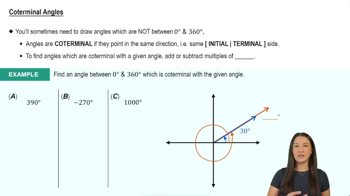
Coterminal Angles

Coterminal angles are angles that share the same initial and terminal sides but differ by full rotations of 360° or 2π radians. To find a coterminal angle, you add or subtract multiples of 360° (or 2π) until the angle lies within the desired range.
Recommended video:
04:46
Coterminal Angles

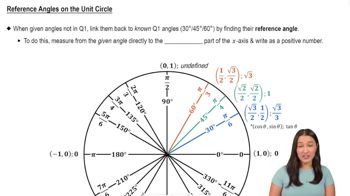
Angle Measurement in Degrees

Angles can be measured in degrees, where one full rotation equals 360°. Understanding how to manipulate angles in degrees, including adding or subtracting 360°, is essential for finding equivalent angles within a specified interval.
Recommended video:
5:31
Reference Angles on the Unit Circle

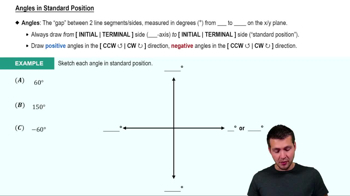
Positive Angle Restriction

When asked to find a positive angle less than 360°, you must adjust the given angle by adding 360° repeatedly until the result is positive and less than 360°. This ensures the angle is expressed within the standard range for one full rotation.
Recommended video:
05:50
Drawing Angles in Standard Position
Related Practice
Textbook Question

In Exercises 9–16, use the given triangles to evaluate each expression. If necessary, express the value without a square root in the denominator by rationalizing the denominator.

sin 𝜋/4 - cos 𝜋/4

1
views
Textbook Question

In Exercises 5–18, the unit circle has been divided into twelve equal arcs, corresponding to t-values of


0, 𝜋, 𝜋, 𝜋, 2𝜋, 5𝜋, 𝜋, 7𝜋, 4𝜋, 3𝜋, 5𝜋, 11𝜋, and 2𝜋.

6 3 2 3 6 6 3 2 3 6


Use the (x,y) coordinates in the figure to find the value of each trigonometric function at the indicated real number, t, or state that the expression is undefined.

<IMAGE>


In Exercises 11–18, continue to refer to the figure at the bottom of the previous page.

sec 11𝜋/6

12
views
Textbook Question

In Exercises 9–16, use the given triangles to evaluate each expression. If necessary, express the value without a square root in the denominator by rationalizing the denominator.

tan 𝜋/4 + csc 𝜋/6

2
views
Textbook Question
In Exercises 5–18, the unit circle has been divided into twelve equal arcs, corresponding to t-values of0, 𝜋, 𝜋, 𝜋, 2𝜋, 5𝜋, 𝜋, 7𝜋, 4𝜋, 3𝜋, 5𝜋, 11𝜋, and 2𝜋.6 3 2 3 6 6 3 2 3 6Use the (x,y) coordinates in the figure to find the value of each trigonometric function at the indicated real number, t, or state that the expression is undefined.

In Exercises 11–18, continue to refer to the figure at the bottom of the previous page.sec 5𝜋/3
1
views
Textbook Question

Use the given triangles to evaluate each expression. If necessary, express the value without a square root in the denominator by rationalizing the denominator.


<IMAGE>


tan 𝜋/3

4
views
Textbook Question

The unit circle has been divided into twelve equal arcs, corresponding to t-values of

0, 𝜋/6, 𝜋/3, 𝜋/2, 2𝜋/3, 5𝜋/6, 𝜋, 7𝜋/6, 4𝜋/3, 3𝜋/2, 5𝜋/3, 11𝜋/6, and 2𝜋


Use the (x,y) coordinates in the figure to find the value of each trigonometric function at the indicated real number, t, or state that the expression is undefined.

<IMAGE>


sin 3𝜋/2