Ch. 1 - Angles and the Trigonometric Functions
Blitzer - Trigonometry 3rd Edition
Blitzer3rd EditionTrigonometryISBN: 9780137316601Not the one you use?Change textbook
Chapter 1, Problem 1

In Exercises 1–8, a point on the terminal side of angle θ is given. Find the exact value of each of the six trigonometric functions of θ. (-4, 3)

Verified step by step guidance
1
Identify the coordinates of the point on the terminal side of angle \( \theta \). Here, the point is \((-4, 3)\), so \(x = -4\) and \(y = 3\).
Calculate the radius \(r\), which is the distance from the origin to the point, using the formula \(r = \sqrt{x^2 + y^2}\). Substitute the values to get \(r = \sqrt{(-4)^2 + 3^2}\).
Recall the definitions of the six trigonometric functions in terms of \(x\), \(y\), and \(r\): \[ \sin \theta = \frac{y}{r}, \quad \cos \theta = \frac{x}{r}, \quad \tan \theta = \frac{y}{x} \] \[ \csc \theta = \frac{r}{y}, \quad \sec \theta = \frac{r}{x}, \quad \cot \theta = \frac{x}{y} \]
Substitute the values of \(x\), \(y\), and \(r\) into each of the six functions to express them exactly in terms of radicals and integers.
Consider the signs of the trigonometric functions based on the quadrant where the point \((-4, 3)\) lies. Since \(x < 0\) and \(y > 0\), the point is in the second quadrant, which affects the signs of sine, cosine, and tangent.

Verified video answer for a similar problem:

This video solution was recommended by our tutors as helpful for the problem above.
Video duration:
5m
Was this helpful?

Key Concepts

Here are the essential concepts you must grasp in order to answer the question correctly.

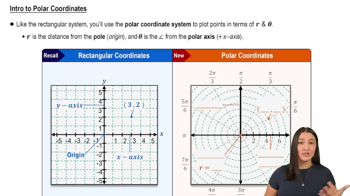
Coordinates and the Terminal Side of an Angle

The terminal side of an angle θ in standard position passes through a point (x, y). This point's coordinates help determine the angle's trigonometric values by relating x and y to the radius (r), which is the distance from the origin to the point.
Recommended video:
05:32
Intro to Polar Coordinates

Radius (r) and the Distance Formula

The radius r is the distance from the origin to the point (x, y) on the terminal side, calculated using the distance formula r = √(x² + y²). This value is essential for normalizing the coordinates to find sine, cosine, and other trigonometric functions.
Recommended video:
6:36
Quadratic Formula

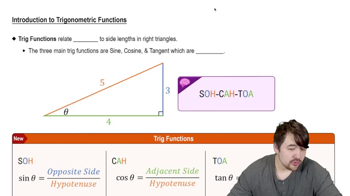
Definition of the Six Trigonometric Functions

The six trigonometric functions—sine, cosine, tangent, cosecant, secant, and cotangent—are defined using x, y, and r: sin θ = y/r, cos θ = x/r, tan θ = y/x, and their reciprocals. Knowing these definitions allows calculation of exact values from the given point.
Recommended video:
6:04
Introduction to Trigonometric Functions