In Exercises 61–86, use reference angles to find the exact value of each expression. Do not use a calculator. sin(-240°)
Ch. 1 - Angles and the Trigonometric Functions

Chapter 1, Problem 1.2.72
If θ is an acute angle and cos θ = 1/3, find csc (𝜋/2 - θ).
Verified step by step guidance1
Recall the co-function identity for sine and cosine: \(\sin\left(\frac{\pi}{2} - \theta\right) = \cos\theta\).
Since \(\csc x = \frac{1}{\sin x}\), express \(\csc\left(\frac{\pi}{2} - \theta\right)\) as \(\frac{1}{\sin\left(\frac{\pi}{2} - \theta\right)}\).
Substitute the co-function identity into the expression: \(\csc\left(\frac{\pi}{2} - \theta\right) = \frac{1}{\cos\theta}\).
Use the given value \(\cos\theta = \frac{1}{3}\) to rewrite the expression as \(\csc\left(\frac{\pi}{2} - \theta\right) = \frac{1}{\frac{1}{3}}\).
Simplify the fraction to find the expression for \(\csc\left(\frac{\pi}{2} - \theta\right)\) in terms of the given cosine value.

Verified video answer for a similar problem:
This video solution was recommended by our tutors as helpful for the problem above.
Video duration:
2mWas this helpful?
Key Concepts
Here are the essential concepts you must grasp in order to answer the question correctly.
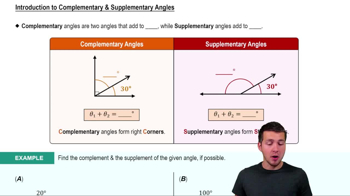
Complementary Angles in Trigonometry
Complementary angles are two angles whose measures add up to 90° (or π/2 radians). In trigonometry, the sine of an angle equals the cosine of its complement, i.e., sin(π/2 - θ) = cos θ. This relationship helps simplify expressions involving complementary angles.
Recommended video:
Intro to Complementary & Supplementary Angles
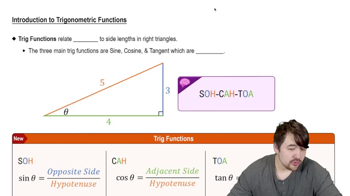
Reciprocal Trigonometric Functions
Reciprocal functions are the inverses of the basic trigonometric functions. For example, cosecant (csc) is the reciprocal of sine, defined as csc θ = 1/sin θ. Understanding this helps in converting between sine and cosecant values to solve problems.
Recommended video:
Introduction to Trigonometric Functions
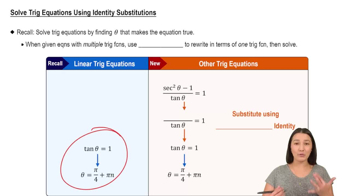
Using Given Values to Find Trigonometric Ratios
Given a trigonometric value like cos θ = 1/3, you can find related ratios using identities. Since sin(π/2 - θ) = cos θ, knowing cos θ allows direct calculation of sin(π/2 - θ), and thus csc(π/2 - θ) by taking the reciprocal. This approach simplifies problem-solving.
Recommended video:
Solve Trig Equations Using Identity Substitutions
Related Practice
Textbook Question
1
views
Textbook Question
In Exercises 55–58, use a calculator to find the value of the acute angle θ to the nearest degree. sin θ = 0.2974
2
views
Textbook Question
In Exercises 59–62, use a calculator to find the value of the acute angle θ in radians, rounded to three decimal places. cos θ = 0.4112
1
views
Textbook Question
In Exercises 57–70, find a positive angle less than or that is coterminal with the given angle. -150°
3
views
Textbook Question
In Exercises 55–58, use a calculator to find the value of the acute angle θ to the nearest degree. tan θ = 4.6252
4
views
Textbook Question
In Exercises 71–74, find the length of the arc on a circle of radius r intercepted by a central angle θ. Express arc length in terms of 𝜋. Then round your answer to two decimal places. Radius, r: 8 feet Central Angle, θ: θ = 225°