Skip to main content
Trigonometry
My Course
Learn
Exam Prep
AI Tutor
Study Guides
Textbook Solutions
Flashcards
Explore
Try the app
My Course
Learn
Exam Prep
AI Tutor
Study Guides
Textbook Solutions
Flashcards
Explore
Try the app
Back
Products and Quotients of Complex Numbers definitions
You can tap to flip the card.
Polar Form
You can tap to flip the card.
👆
Polar Form
A representation using a magnitude and an angle, simplifying multiplication and division of complex numbers.
Track progress
Control buttons has been changed to "navigation" mode.
1/15
Related flashcards
Related practice
Recommended videos
Products and Quotients of Complex Numbers quiz
Products and Quotients of Complex Numbers
15 Terms
Products and Quotients of Complex Numbers
11. Graphing Complex Numbers
2 problems
Topic
Patrick
Powers of Complex Numbers (DeMoivre's Theorem)
11. Graphing Complex Numbers
4 problems
Topic
Patrick
11. Graphing Complex Numbers
4 topics
8 problems
Chapter
Patrick
03:40
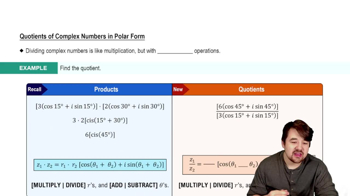
Quotients of Complex Numbers in Polar Form
4
views
04:46
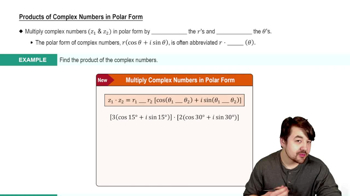
Products of Complex Numbers in Polar Form
4
views
Terms in this set (15)
Hide definitions
Polar Form
A representation using a magnitude and an angle, simplifying multiplication and division of complex numbers.
Magnitude
The r value in polar form, indicating the distance from the origin in the complex plane.
Angle
The theta value in polar form, specifying the direction of the complex number from the positive real axis.
Product
The result of multiplying two complex numbers, found by multiplying magnitudes and adding angles.
Quotient
The result of dividing two complex numbers, found by dividing magnitudes and subtracting angles.
cis Notation
A compact way to write complex numbers in polar form, replacing cosine and sine expressions.
Rectangular Form
A representation using real and imaginary parts, often converted to polar form for easier operations.
Radians
A unit for measuring angles, commonly used in polar form calculations for complex numbers.
Degrees
A unit for measuring angles, used alongside radians in polar form examples.
Addition
The operation applied to angles when multiplying complex numbers in polar form.
Subtraction
The operation applied to angles when dividing complex numbers in polar form.
Fraction
A form used for angles in radians, often requiring common denominators for simplification.
Simplification
The process of reducing expressions, such as combining fractions or reducing ratios in polar form.
Complex Plane
A graphical representation where complex numbers are plotted using real and imaginary axes.
Equation
A mathematical statement used to perform operations on complex numbers in polar form.
 BackBack
 03:40
03:40