Skip to main content
Trigonometry
My Course
Learn
Exam Prep
AI Tutor
Study Guides
Textbook Solutions
Flashcards
Explore
Try the app
My Course
Learn
Exam Prep
AI Tutor
Study Guides
Textbook Solutions
Flashcards
Explore
Try the app
Back
Graphs of the Sine and Cosine Functions definitions
You can tap to flip the card.
Unit Circle
You can tap to flip the card.
👆
Unit Circle
A circle with radius 1 used to relate trigonometric functions to coordinates, forming the basis for graphing sine and cosine.
Track progress
Control buttons has been changed to "navigation" mode.
1/15
Related flashcards
Related practice
Recommended videos
Graphs of the Sine and Cosine Functions quiz #1
Graphs of the Sine and Cosine Functions
14 Terms
Graphs of the Sine and Cosine Functions
4. Graphing Trigonometric Functions
3 problems
Topic
Patrick
Phase Shifts
4. Graphing Trigonometric Functions
3 problems
Topic
AllySteele
4. Graphing Trigonometric Functions
4 topics
8 problems
Chapter
Patrick
02:43
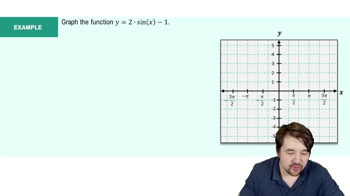
Example 1
4
views
5:05
Amplitude and Reflection of Sine and Cosine
6
views
5:53
Graph of Sine and Cosine Function
7
views
Terms in this set (15)
Hide definitions
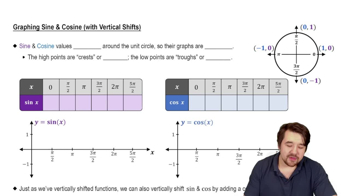
Unit Circle
A circle with radius 1 used to relate trigonometric functions to coordinates, forming the basis for graphing sine and cosine.
Wave Pattern
A repeating curve seen in sine and cosine graphs, resulting from periodic values traced from the unit circle.
Crest
A high point on a sine or cosine graph, representing the maximum value reached during a cycle.
Trough
A low point on a sine or cosine graph, representing the minimum value reached during a cycle.
Midline
A horizontal line through the center of a wave, used to measure amplitude and identify vertical shifts.
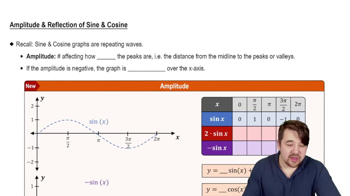
Amplitude
The distance from the midline to a peak or valley, indicating the height of the wave in sine or cosine graphs.
Vertical Shift
A transformation that moves the entire graph of a function up or down by adding a constant.
Reflection
A transformation that flips the graph over the x-axis, caused by a negative amplitude.
Period
The length along the x-axis for one complete cycle of a wave, calculated using 2π divided by a coefficient.
Cycle
A full sequence of repeating values in a wave, from one crest to the next or one trough to the next.
Peak
A point of maximum value on a wave, synonymous with crest, marking the highest output.
Valley
A point of minimum value on a wave, synonymous with trough, marking the lowest output.
Horizontal Stretch
A transformation that widens the graph, increasing the period when the coefficient inside the function is less than one.
Horizontal Shrink
A transformation that compresses the graph, decreasing the period when the coefficient inside the function is greater than one.
Coefficient
A number placed in front of x inside the function, affecting the period and horizontal transformations of the graph.
 BackBack

 02:43
02:43