Back

Evaluate Composite Trig Functions quiz

Control buttons has been changed to "navigation" mode.
1/15
  • What is the first step when evaluating a composite trig function like sin(cos⁻¹(1/2))?

    Start by evaluating the innermost function first, which in this case is cos⁻¹(1/2).
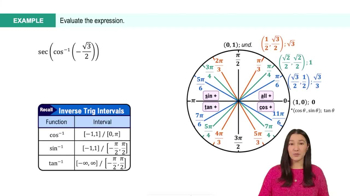
  • How do you interpret cos⁻¹(1/2) in terms of the unit circle?

    You look for the angle whose cosine is 1/2, which is π/3 on the unit circle.
  • What is the value of sin(cos⁻¹(1/2))?

    It is √3/2, because sin(π/3) = √3/2.
  • Why can't you always cancel a trig function with its inverse in composite expressions?

    Because the inverse trig functions are only defined on specific intervals, so the result may not be the original input.
  • What is the interval for the output of the inverse tangent function?

    The interval is from -π/2 to π/2.
  • What is cos(tan⁻¹(0))?

    It is 1, because tan⁻¹(0) = 0 and cos(0) = 1.
  • What is the value of cos⁻¹(sin(π/3))?

    It is π/6, because sin(π/3) = √3/2 and cos⁻¹(√3/2) = π/6.
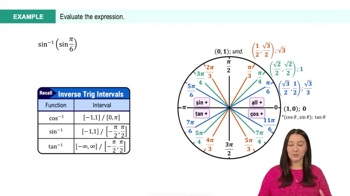
  • Why is cos⁻¹(cos(11π/6)) not equal to 11π/6?

    Because 11π/6 is not in the interval [0, π] for inverse cosine, so you must find the equivalent angle within that interval.
  • What is the value of cos⁻¹(cos(11π/6))?

    It is π/6, since cos(11π/6) = √3/2 and cos⁻¹(√3/2) = π/6.
  • Why is sin⁻¹(2) undefined?

    Because the domain of the inverse sine function is only between -1 and 1, and 2 is outside this range.
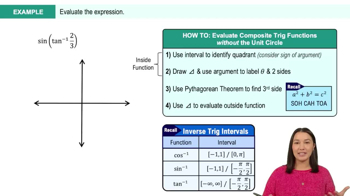
  • How do you evaluate sin(tan⁻¹(3/4)) if 3/4 is not on the unit circle?

    Draw a right triangle with opposite side 3 and adjacent side 4, then use the Pythagorean theorem to find the hypotenuse and calculate the sine.
  • What is the value of sin(tan⁻¹(3/4))?

    It is 3/5, since the triangle has sides 3, 4, and 5, and sine is opposite over hypotenuse.
  • When should you draw a right triangle to evaluate a composite trig function?

    When the argument is not a standard value on the unit circle, especially with non-standard fractions.
  • How do you determine the quadrant for your triangle when evaluating sin(cos⁻¹(-5/13))?

    Since cos⁻¹ is defined from 0 to π and the cosine is negative, the angle is in quadrant II.
  • What is the value of sin(cos⁻¹(-5/13)) and why is it positive?

    It is 12/13, because in quadrant II, sine values are positive and the triangle sides yield this ratio.