Skip to main content
Trigonometry
My Course
Learn
Exam Prep
AI Tutor
Study Guides
Textbook Solutions
Flashcards
Explore
Try the app
My Course
Learn
Exam Prep
AI Tutor
Study Guides
Textbook Solutions
Flashcards
Explore
Try the app
Back
Angles in Standard Position definitions
You can tap to flip the card.
Angle
You can tap to flip the card.
👆
Angle
Space formed between two line segments, measured in degrees, representing the gap created at their intersection.
Track progress
Control buttons has been changed to "navigation" mode.
1/13
Related flashcards
Related practice
Recommended videos
Angles in Standard Position quiz #1
Angles in Standard Position
40 Terms
Angles in Standard Position quiz #2
Angles in Standard Position
40 Terms
Angles in Standard Position quiz #3
Angles in Standard Position
40 Terms
Angles in Standard Position
1. Measuring Angles
7 problems
Topic
Patrick
Coterminal Angles
1. Measuring Angles
7 problems
Topic
Patrick
1. Measuring Angles
4 topics
11 problems
Chapter
Patrick
Guided course
3:59
Example 1
Guided course
05:50
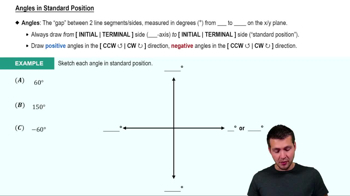
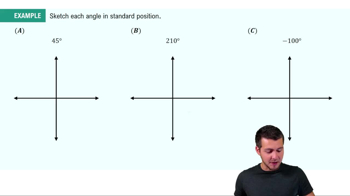
Drawing Angles in Standard Position
2
views
1
rank
Terms in this set (13)
Hide definitions
Angle
Space formed between two line segments, measured in degrees, representing the gap created at their intersection.
Degree
Unit for measuring the size of an angle, ranging from 0 to 360, based on ancient conventions for circles.
X-Y Coordinate System
Grid with horizontal and vertical axes used to sketch and measure angles from a fixed starting point.
Initial Side
Reference line for drawing angles, always placed along the positive horizontal axis in standard sketches.
Terminal Side
Second line segment that defines the angle's extent, positioned away from the reference axis.
Standard Position
Convention for sketching angles with the reference side on the positive horizontal axis and measuring from there.
Positive Angle
Angle measured counterclockwise from the reference axis, following the established mathematical convention.
Negative Angle
Angle measured clockwise from the reference axis, indicating a direction opposite to positive angles.
Acute Angle
Type of angle with a measure less than 90 degrees, often appearing in sketches and classifications.
Obtuse Angle
Type of angle with a measure greater than 90 degrees but less than 180 degrees, used in classification.
Right Angle
Type of angle with a measure exactly equal to 90 degrees, forming a perfect quarter turn.
Quadrant
Section of the coordinate grid, each spanning 90 degrees, used to locate and sketch angles.
Protractor
Instrument for estimating and drawing angles, helpful for visualizing degree measures on sketches.
 BackBack
 3:59
3:59