Determine whether each equation is an identity, a conditional equation, or a contradiction. Give the solution set. See Example 4. -2(x + 3) = -6(x + 7)
Table of contents
- 0. Review of College Algebra4h 43m
- 1. Measuring Angles40m
- 2. Trigonometric Functions on Right Triangles2h 5m
- 3. Unit Circle1h 19m
- 4. Graphing Trigonometric Functions1h 19m
- 5. Inverse Trigonometric Functions and Basic Trigonometric Equations1h 41m
- 6. Trigonometric Identities and More Equations2h 34m
- 7. Non-Right Triangles1h 38m
- 8. Vectors2h 25m
- 9. Polar Equations2h 5m
- 10. Parametric Equations1h 6m
- 11. Graphing Complex Numbers1h 7m
- OLD 1. Angles and the Trigonometric Functions Coming soon
- OLD 2. Trigonometric Functions graphs, Inverse Trigonometric Functions Coming soon
- OLD 3. Trigonometric Identities and Equations Coming soon
- OLD 4. Laws of Sines, Cosines and Vectors Coming soon
- OLD 5. Complex Numbers, Polar Coordinates and Parametric Equations Coming soon
- NEW (not used) 7. Laws of Sines, Cosines and Vectors Coming soon
- NEW (not used) 8. Vectors Coming soon
- NEW(not used) 9. Polar equations Coming soon
- NEW (not used) 11. Graphing Complex Numbers Coming soon
0. Review of College Algebra
Solving Linear Equations
Problem R.6.89
Textbook Question
Solve each inequality. Give the solution set using interval notation. See Examples 8 and 9. 4x + 7 ———— ≤ 2x + 5 -3
Verified step by step guidance1
Start by rewriting the inequality clearly: \(\frac{4x + 7}{-3} \leq 2x + 5\).
Multiply both sides of the inequality by \(-3\) to eliminate the denominator. Remember, multiplying by a negative number reverses the inequality sign, so the inequality becomes: \(4x + 7 \geq -3(2x + 5)\).
Distribute the \(-3\) on the right side: \(4x + 7 \geq -6x - 15\).
Collect like terms by adding \$6x$ to both sides and subtracting \(7\) from both sides: \(4x + 6x \geq -15 - 7\), which simplifies to \(10x \geq -22\).
Finally, divide both sides by \(10\) (a positive number, so the inequality sign stays the same): \(x \geq \frac{-22}{10}\). Express the solution set in interval notation as \([\frac{-22}{10}, \infty)\).
Verified video answer for a similar problem:This video solution was recommended by our tutors as helpful for the problem above
Video duration:
4mPlay a video:
0 Comments
Key Concepts
Here are the essential concepts you must grasp in order to answer the question correctly.
Solving Rational Inequalities
Rational inequalities involve expressions with variables in the numerator and denominator. To solve them, first bring all terms to one side to form a single rational expression, then determine where the expression is positive or negative by analyzing critical points from the numerator and denominator.
Recommended video:
Guided course
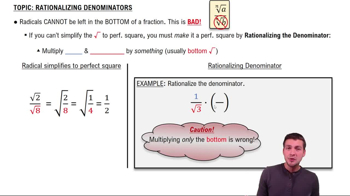
Rationalizing Denominators
Critical Points and Sign Analysis
Critical points occur where the numerator or denominator equals zero, dividing the number line into intervals. By testing values in each interval, you can determine the sign of the rational expression, which helps identify where the inequality holds true.
Recommended video:
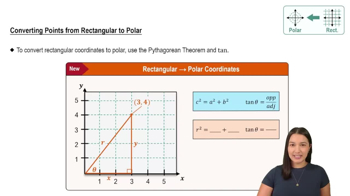
Convert Points from Rectangular to Polar
Interval Notation and Domain Restrictions
Interval notation expresses solution sets compactly using parentheses and brackets. When solving inequalities with denominators, exclude values that make the denominator zero, as these are not in the domain, ensuring the solution set respects these restrictions.
Recommended video:
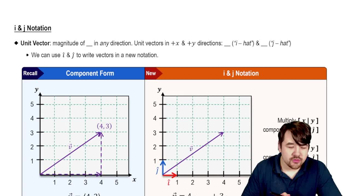
i & j Notation
Related Videos
Related Practice
Textbook Question