In Exercises 85–96, use a calculator to solve each equation, correct to four decimal places, on the interval [0, 2𝝅). 4 tan² x - 8 tan x + 3 = 0
Table of contents
- 0. Review of College Algebra4h 43m
- 1. Measuring Angles40m
- 2. Trigonometric Functions on Right Triangles2h 5m
- 3. Unit Circle1h 19m
- 4. Graphing Trigonometric Functions1h 19m
- 5. Inverse Trigonometric Functions and Basic Trigonometric Equations1h 41m
- 6. Trigonometric Identities and More Equations2h 34m
- 7. Non-Right Triangles1h 38m
- 8. Vectors2h 25m
- 9. Polar Equations2h 5m
- 10. Parametric Equations1h 6m
- 11. Graphing Complex Numbers1h 7m
- OLD 1. Angles and the Trigonometric Functions Coming soon
- OLD 2. Trigonometric Functions graphs, Inverse Trigonometric Functions Coming soon
- OLD 3. Trigonometric Identities and Equations Coming soon
- OLD 4. Laws of Sines, Cosines and Vectors Coming soon
- OLD 5. Complex Numbers, Polar Coordinates and Parametric Equations Coming soon
- NEW (not used) 7. Laws of Sines, Cosines and Vectors Coming soon
- NEW (not used) 8. Vectors Coming soon
- NEW(not used) 9. Polar equations Coming soon
- NEW (not used) 11. Graphing Complex Numbers Coming soon
5. Inverse Trigonometric Functions and Basic Trigonometric Equations
Linear Trigonometric Equations
Problem 3.RE.50
Textbook Question
In Exercises 50–53, find all solutions of each equation. cos x = ﹣1/2
Verified step by step guidance1
Recognize that the equation is \(\cos x = -\frac{1}{2}\). We need to find all angles \(x\) where the cosine value is \(-\frac{1}{2}\).
Recall the unit circle values where \(\cos x = \pm \frac{1}{2}\). Specifically, \(\cos x = \frac{1}{2}\) at \(x = \frac{\pi}{3}\) and \(x = \frac{5\pi}{3}\), so for \(\cos x = -\frac{1}{2}\), the solutions will be in the second and third quadrants.
Identify the reference angle \(\theta\) such that \(\cos \theta = \frac{1}{2}\). This reference angle is \(\theta = \frac{\pi}{3}\).
Write the general solutions for \(\cos x = -\frac{1}{2}\) using the reference angle and the fact that cosine is negative in the second and third quadrants: \(x = \pi - \frac{\pi}{3} + 2k\pi\) and \(x = \pi + \frac{\pi}{3} + 2k\pi\), where \(k\) is any integer.
Simplify the expressions to get \(x = \frac{2\pi}{3} + 2k\pi\) and \(x = \frac{4\pi}{3} + 2k\pi\). These represent all solutions to the equation \(\cos x = -\frac{1}{2}\).
Verified video answer for a similar problem:This video solution was recommended by our tutors as helpful for the problem above
Video duration:
3mPlay a video:
0 Comments
Key Concepts
Here are the essential concepts you must grasp in order to answer the question correctly.
Basic Trigonometric Equations
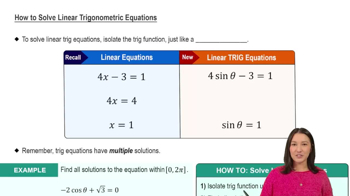
Solving trigonometric equations involves finding all angles x that satisfy the given equation within a specified domain. For example, solving cos x = -1/2 means identifying all angles where the cosine value equals -0.5, considering the periodic nature of cosine.
Recommended video:
How to Solve Linear Trigonometric Equations
Unit Circle and Reference Angles
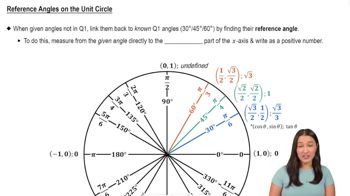
The unit circle helps visualize cosine values as the x-coordinate of points on the circle. To solve cos x = -1/2, one finds the reference angle where cosine is 1/2 and then determines the angles in the appropriate quadrants where cosine is negative (second and third quadrants).
Recommended video:
Reference Angles on the Unit Circle
General Solution for Cosine Equations
Because cosine is periodic with period 2π, the general solutions for cos x = a are x = ±θ + 2kπ, where θ is the reference angle and k is any integer. This accounts for all possible solutions over the real numbers.
Recommended video:
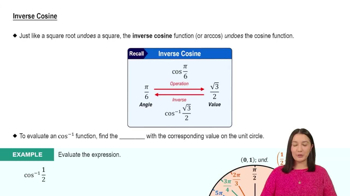
Inverse Cosine
Related Videos
Related Practice
Textbook Question
1
views