Write parametric equations for the rectangular equation below.
Table of contents
- 0. Review of College Algebra4h 43m
- 1. Measuring Angles40m
- 2. Trigonometric Functions on Right Triangles2h 5m
- 3. Unit Circle1h 19m
- 4. Graphing Trigonometric Functions1h 19m
- 5. Inverse Trigonometric Functions and Basic Trigonometric Equations1h 41m
- 6. Trigonometric Identities and More Equations2h 34m
- 7. Non-Right Triangles1h 38m
- 8. Vectors2h 25m
- 9. Polar Equations2h 5m
- 10. Parametric Equations1h 6m
- 11. Graphing Complex Numbers1h 7m
- OLD 1. Angles and the Trigonometric Functions Coming soon
- OLD 2. Trigonometric Functions graphs, Inverse Trigonometric Functions Coming soon
- OLD 3. Trigonometric Identities and Equations Coming soon
- OLD 4. Laws of Sines, Cosines and Vectors Coming soon
- OLD 5. Complex Numbers, Polar Coordinates and Parametric Equations Coming soon
- NEW (not used) 7. Laws of Sines, Cosines and Vectors Coming soon
- NEW (not used) 8. Vectors Coming soon
- NEW(not used) 9. Polar equations Coming soon
- NEW (not used) 11. Graphing Complex Numbers Coming soon
10. Parametric Equations
Writing Parametric Equations
Problem 5.5.55
Textbook Question
In Exercises 53–56, find two different sets of parametric equations for each rectangular equation. y = x² + 4
Verified step by step guidance1
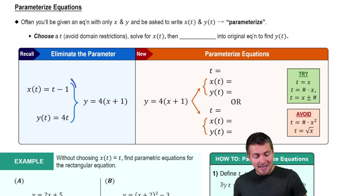
Recognize that the given rectangular equation is a parabola: \(y = x^{2} + 4\). Our goal is to express both \(x\) and \(y\) in terms of a parameter \(t\) to form parametric equations.
For the first set of parametric equations, let the parameter \(t\) represent \(x\). So, set \(x = t\). Then, substitute \(t\) into the original equation to find \(y\): \(y = t^{2} + 4\). Thus, the first set is \(x = t\), \(y = t^{2} + 4\).
For the second set, choose a different parameterization. For example, let \(t\) represent \(y\). From the original equation, solve for \(x\) in terms of \(y\): \(x = \pm \sqrt{y - 4}\). To avoid ambiguity, pick one branch, say the positive root, and set \(y = t\). Then, \(x = \sqrt{t - 4}\). So the second set is \(x = \sqrt{t - 4}\), \(y = t\), with the domain \(t \geq 4\).
Alternatively, for the second set, you can introduce a trigonometric parameterization by letting \(x = 2 \tan t\). Substitute into the original equation: \(y = (2 \tan t)^{2} + 4 = 4 \tan^{2} t + 4\). So the parametric equations become \(x = 2 \tan t\), \(y = 4 \tan^{2} t + 4\), where \(t\) is in the domain where \(\tan t\) is defined.
Summarize that parametric equations are flexible and can be chosen by assigning the parameter to either \(x\), \(y\), or a function of \(t\), then expressing the other variable accordingly to satisfy the original rectangular equation.
Verified video answer for a similar problem:This video solution was recommended by our tutors as helpful for the problem above
Video duration:
1mPlay a video:
0 Comments
Key Concepts
Here are the essential concepts you must grasp in order to answer the question correctly.
Rectangular and Parametric Equations
A rectangular equation relates x and y directly, while parametric equations express both x and y as functions of a third variable, usually t. Converting between these forms allows for different representations of the same curve, useful in analyzing motion or graphing.
Recommended video:
Guided course
Parameterizing Equations
Parametrization Techniques
Parametrization involves choosing a parameter t and expressing x and y in terms of t to satisfy the original equation. Common methods include letting x = t and solving for y, or using trigonometric or polynomial functions to create alternative parameter sets.
Recommended video:
Guided course
Parameterizing Equations
Quadratic Functions and Their Graphs
The given equation y = x² + 4 is a parabola shifted upward by 4 units. Understanding the shape and properties of quadratic functions helps in selecting appropriate parametric forms that trace the curve accurately.
Recommended video:
Quadratic Formula
Related Videos
Related Practice
Multiple Choice