Ch. 3 - Trigonometric Identities and Equations
Blitzer - Trigonometry 3rd Edition
Blitzer3rd EditionTrigonometryISBN: 9780137316601Not the one you use?Change textbook
Chapter 3, Problem 3.RE.35d

In Exercises 35–38, find the exact value of the following under the given conditions:
d. sin 2α
sin α = 3/5, 0 < α < 𝝅/2, and sin β = 12/13, 𝝅/2 < β < 𝝅.

Verified step by step guidance
1
Identify the given information: \(\sin \alpha = \frac{3}{5}\) with \(0 < \alpha < \frac{\pi}{2}\), and \(\sin \beta = \frac{12}{13}\) with \(\frac{\pi}{2} < \beta < \pi\).
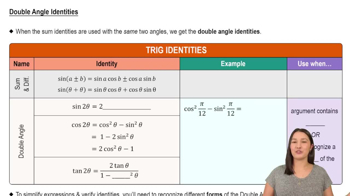
Recall the double-angle identity for sine: \(\sin 2\alpha = 2 \sin \alpha \cos \alpha\).
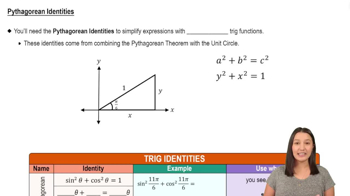
Since \(\sin \alpha\) is known, find \(\cos \alpha\) using the Pythagorean identity: \(\cos \alpha = \sqrt{1 - \sin^2 \alpha}\), considering the quadrant of \(\alpha\) to determine the sign.
Calculate \(\cos \alpha\) by substituting \(\sin \alpha = \frac{3}{5}\) into the identity: \(\cos \alpha = \sqrt{1 - \left(\frac{3}{5}\right)^2}\).
Substitute \(\sin \alpha\) and \(\cos \alpha\) into the double-angle formula \(\sin 2\alpha = 2 \sin \alpha \cos \alpha\) to express \(\sin 2\alpha\) exactly.

Verified video answer for a similar problem:

This video solution was recommended by our tutors as helpful for the problem above.
Video duration:
3m
Was this helpful?

Key Concepts

Here are the essential concepts you must grasp in order to answer the question correctly.

Double-Angle Identity for Sine

The double-angle identity states that sin(2α) = 2 sin(α) cos(α). This formula allows you to find the sine of twice an angle using the sine and cosine of the original angle. Knowing sin(α) and the quadrant of α helps determine cos(α) and thus compute sin(2α) exactly.
Recommended video:
05:06
Double Angle Identities

Using the Pythagorean Identity to Find Cosine

Given sin(α), the cosine can be found using cos²(α) = 1 - sin²(α). The sign of cos(α) depends on the quadrant where α lies. Since 0 < α < π/2 (first quadrant), cos(α) is positive, enabling exact calculation of cos(α) from sin(α).
Recommended video:
6:25
Pythagorean Identities

Understanding Angle Quadrants and Their Significance

The quadrant of an angle determines the signs of its sine and cosine values. For example, if 0 < α < π/2, both sine and cosine are positive. For β in (π/2, π), sine is positive but cosine is negative. This knowledge is essential for correctly determining trigonometric values and applying identities.
Recommended video:
6:36
Quadratic Formula