Find the exact value of s in the given interval that has the given circular function value. [ 0, π/2] ; cos s = √2/2
Verified step by step guidance
1
Identify the range of the angle: The problem specifies the interval \([0, \pi/2]\), which means we are looking for an angle in the first quadrant.
Recall the cosine values for special angles: In the first quadrant, \(\cos(\pi/4) = \frac{\sqrt{2}}{2}\).
Compare the given cosine value with known values: The given value \(\cos s = \frac{\sqrt{2}}{2}\) matches the cosine of \(\pi/4\).
Verify the angle is within the specified interval: Since \(\pi/4\) is within \([0, \pi/2]\), it is a valid solution.
Conclude that the exact value of \(s\) is \(\pi/4\) within the given interval.
Verified video answer for a similar problem:
This video solution was recommended by our tutors as helpful for the problem above
Play a video:
0 Comments
Key Concepts
Here are the essential concepts you must grasp in order to answer the question correctly.
Cosine Function
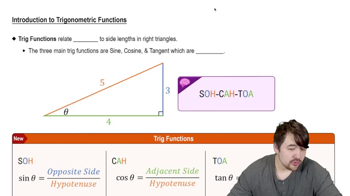
The cosine function is a fundamental trigonometric function that relates the angle of a right triangle to the ratio of the length of the adjacent side to the hypotenuse. It is defined for all real numbers and is periodic with a period of 2π. The cosine function takes values between -1 and 1, and specific angles yield well-known cosine values, such as cos(π/4) = √2/2.
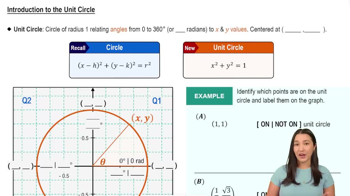
The unit circle is a circle with a radius of one centered at the origin of a coordinate plane. It is a crucial tool in trigonometry, as it allows for the visualization of the sine and cosine functions. The coordinates of any point on the unit circle correspond to the cosine and sine of the angle formed with the positive x-axis, making it easier to determine exact values for trigonometric functions.
Principal values refer to the specific angles within a defined interval where a trigonometric function takes a particular value. For cosine, the principal values are typically found in the intervals [0, π] for angles in radians. In this case, since we are looking for s in the interval [0, π/2], we need to identify the angle whose cosine equals √2/2, which is π/4.

 Verified step by step guidance
 5:53
5:53