Ch. 1 - Angles and the Trigonometric Functions
Blitzer - Trigonometry 3rd Edition
Blitzer3rd EditionTrigonometryISBN: 9780137316601Not the one you use?Change textbook
Chapter 1, Problem 36

Find a cofunction with the same value as the given expression.
tan (𝜋/7)

Verified step by step guidance
1
Recall the cofunction identity for tangent: \( \tan(\theta) = \cot\left(\frac{\pi}{2} - \theta\right) \). This means the tangent of an angle is equal to the cotangent of its complement.
Identify the given angle \( \theta = \frac{\pi}{7} \). We want to find a cofunction expression that has the same value as \( \tan\left(\frac{\pi}{7}\right) \).
Calculate the complementary angle for the cofunction by subtracting \( \theta \) from \( \frac{\pi}{2} \): \( \frac{\pi}{2} - \frac{\pi}{7} \).
Simplify the complementary angle: find a common denominator and subtract the fractions to get \( \frac{7\pi}{14} - \frac{2\pi}{14} = \frac{5\pi}{14} \).
Write the cofunction expression using the cotangent function: \( \tan\left(\frac{\pi}{7}\right) = \cot\left(\frac{5\pi}{14}\right) \).

Verified video answer for a similar problem:

This video solution was recommended by our tutors as helpful for the problem above.
Video duration:
2m

Key Concepts

Here are the essential concepts you must grasp in order to answer the question correctly.

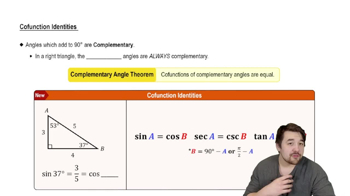
Cofunction Identities

Cofunction identities relate trigonometric functions of complementary angles, such as sin(θ) = cos(π/2 - θ) and tan(θ) = cot(π/2 - θ). These identities allow expressing one function in terms of another evaluated at the complementary angle.
Recommended video:
6:30
Cofunction Identities

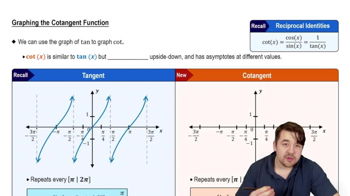
Tangent and Cotangent Relationship

Tangent and cotangent are reciprocal functions: tan(θ) = 1/cot(θ). Using cofunction identities, tan(θ) can be expressed as cot(π/2 - θ), which helps find equivalent expressions involving complementary angles.
Recommended video:
5:37
Introduction to Cotangent Graph

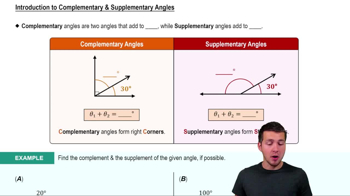
Radian Measure and Angle Complementarity

Angles in trigonometry are often measured in radians, where π radians equal 180 degrees. Complementary angles sum to π/2 radians (90 degrees), a key concept when applying cofunction identities to find equivalent trigonometric values.
Recommended video:
Guided course
3:35
Intro to Complementary & Supplementary Angles