In Exercises 18–24, graph two full periods of the given tangent or cotangent function. y = − 1/2 cot π/2 x
Ch. 2 - Graphs of the Trigonometric Functions; Inverse Trigonometric Functions

All textbooks
Blitzer 3rd Edition
Ch. 2 - Graphs of the Trigonometric Functions; Inverse Trigonometric Functions
Problem 24
Blitzer 3rd Edition
Ch. 2 - Graphs of the Trigonometric Functions; Inverse Trigonometric Functions
Problem 24Chapter 2, Problem 24
Determine the amplitude, period, and phase shift of each function. Then graph one period of the function.
y = 1/2 sin(x + π)
Verified step by step guidance1
Identify the general form of the sine function: \(y = A \sin(B(x - C))\), where \(A\) is the amplitude, \(\frac{2\pi}{B}\) is the period, and \(C\) is the phase shift.
Rewrite the given function \(y = \frac{1}{2} \sin(x + \pi)\) in the form \(y = A \sin(B(x - C))\). Notice that \(x + \pi\) can be written as \(x - (-\pi)\), so here \(A = \frac{1}{2}\), \(B = 1\), and \(C = -\pi\).
Determine the amplitude \(A\), which is the absolute value of the coefficient in front of the sine function: \(A = \left| \frac{1}{2} \right|\).
Calculate the period using the formula \(\text{Period} = \frac{2\pi}{B}\). Since \(B = 1\), the period is \(2\pi\).
Find the phase shift \(C\), which is the horizontal shift of the graph. Since \(C = -\pi\), the graph shifts \(\pi\) units to the left. Use this information to sketch one full period of the sine wave starting from \(x = -\pi\) to \(x = -\pi + 2\pi = \pi\).

Verified video answer for a similar problem:
This video solution was recommended by our tutors as helpful for the problem above.
Video duration:
7mWas this helpful?
Key Concepts
Here are the essential concepts you must grasp in order to answer the question correctly.
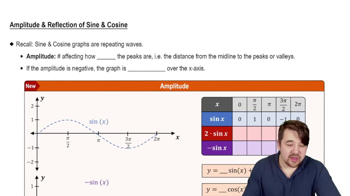
Amplitude of a Sine Function
Amplitude is the maximum absolute value of the sine function's output, representing the height from the midline to the peak. For y = (1/2) sin(x + π), the amplitude is 1/2, indicating the wave oscillates between -1/2 and 1/2.
Recommended video:
Amplitude and Reflection of Sine and Cosine
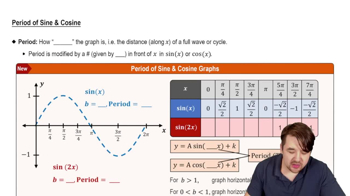
Period of a Sine Function
The period is the length of one complete cycle of the sine wave, calculated as 2π divided by the coefficient of x inside the function. Since the coefficient of x is 1 in y = (1/2) sin(x + π), the period remains 2π.
Recommended video:
Period of Sine and Cosine Functions
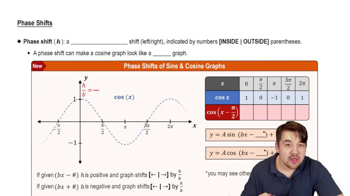
Phase Shift of a Sine Function
Phase shift is the horizontal translation of the sine curve, determined by solving (x + π) = 0, giving a shift of -π. This means the graph is shifted π units to the left compared to the standard sine function.
Recommended video:
Phase Shifts
Related Practice
Textbook Question
2
views
Textbook Question
In Exercises 17–30, determine the amplitude, period, and phase shift of each function. Then graph one period of the function. y = −2 sin(2x + π/2)
3
views
Textbook Question
In Exercises 21–28, an object moves in simple harmonic motion described by the given equation, where t is measured in seconds and d in inches. In each exercise, find the following: a. the maximum displacement b. the frequency c. the time required for one cycle. d = −8 cos π/2 t
22
views
2
rank
Textbook Question
In Exercises 1–26, find the exact value of each expression. _ csc⁻¹ (− 2√3/3)
1
views
Textbook Question
In Exercises 17–30, determine the amplitude, period, and phase shift of each function. Then graph one period of the function. y = 1/2 sin(x + π/2)
Textbook Question
In Exercises 1–26, find the exact value of each expression. _ sec⁻¹ (−√2)