Find the magnitude and direction angle for each vector. Round angle measures to the nearest tenth, as necessary. 〈5, 7〉
Verified step by step guidance
1
Identify the components of the vector. Here, the vector is given as \( \langle 5, 7 \rangle \), where 5 is the x-component and 7 is the y-component.
Calculate the magnitude of the vector using the formula for the length of a vector in the plane: \( \text{magnitude} = \sqrt{x^2 + y^2} \). Substitute the values to get \( \sqrt{5^2 + 7^2} \).
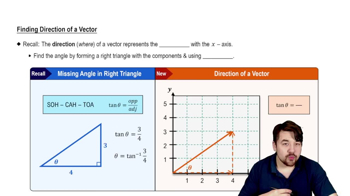
Find the direction angle \( \theta \) of the vector relative to the positive x-axis using the tangent function: \( \tan(\theta) = \frac{y}{x} \). Substitute the values to get \( \tan(\theta) = \frac{7}{5} \).
Use the inverse tangent function (arctangent) to find the angle: \( \theta = \tan^{-1}\left(\frac{7}{5}\right) \). This will give the angle in degrees.
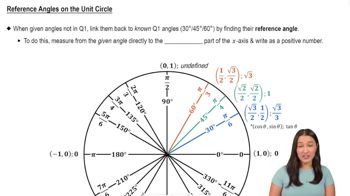
Round the angle to the nearest tenth of a degree as required, and express the direction angle as measured counterclockwise from the positive x-axis.
Verified video answer for a similar problem:
This video solution was recommended by our tutors as helpful for the problem above
Play a video:
0 Comments
Key Concepts
Here are the essential concepts you must grasp in order to answer the question correctly.
Vector Magnitude
The magnitude of a vector represents its length and is calculated using the Pythagorean theorem. For a vector with components (x, y), the magnitude is √(x² + y²). This gives a scalar value indicating how long the vector is regardless of its direction.
The direction angle of a vector is the angle it makes with the positive x-axis, measured counterclockwise. It can be found using the inverse tangent function: θ = arctan(y/x). This angle helps describe the vector's orientation in the plane.
When calculating angles, results often have many decimal places. Rounding to the nearest tenth means keeping one digit after the decimal point, which simplifies the answer while maintaining reasonable accuracy for practical use.

 Verified step by step guidance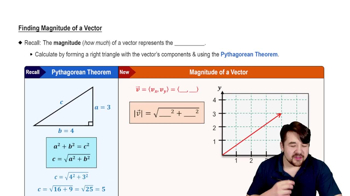
 04:44
04:44