Ch. 2 - Graphs of the Trigonometric Functions; Inverse Trigonometric Functions
Blitzer - Trigonometry 3rd Edition
Blitzer3rd EditionTrigonometryISBN: 9780137316601Not the one you use?Change textbook
Chapter 2, Problem 27

In Exercises 25–28, use each graph to obtain the graph of the corresponding reciprocal function, cosecant or secant. Give the equation of the function for the graph that you obtain.

Verified step by step guidance
1
Identify the original trigonometric function from the given graph, which will be either sine or cosine, since their reciprocals are cosecant and secant respectively.
Recall that the reciprocal function of sine is cosecant, given by \(y = \csc x = \frac{1}{\sin x}\), and the reciprocal function of cosine is secant, given by \(y = \sec x = \frac{1}{\cos x}\).
Locate the points on the original graph where the function crosses the x-axis (i.e., where sine or cosine equals zero). These points will correspond to vertical asymptotes in the reciprocal function's graph because division by zero is undefined.
For each point on the original graph where the function has a maximum or minimum (peaks and troughs), the reciprocal function will have corresponding minimum or maximum values, since the reciprocal of a number greater than 1 is between 0 and 1, and the reciprocal of a number between 0 and 1 is greater than 1.
Sketch the reciprocal function by drawing vertical asymptotes at the zeros of the original function and plotting the reciprocal values of the original function's points, then write the equation of the reciprocal function as either \(y = \csc x\) or \(y = \sec x\) depending on the original function.

Verified video answer for a similar problem:

This video solution was recommended by our tutors as helpful for the problem above.
Video duration:
6m
Was this helpful?

Key Concepts

Here are the essential concepts you must grasp in order to answer the question correctly.

Reciprocal Trigonometric Functions

Reciprocal functions are derived by taking the reciprocal of basic trigonometric functions. Specifically, cosecant (csc) is the reciprocal of sine (sin), and secant (sec) is the reciprocal of cosine (cos). Understanding these relationships helps in transforming graphs of sine and cosine into their reciprocal counterparts.
Recommended video:
6:04
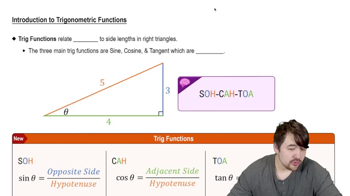
Introduction to Trigonometric Functions

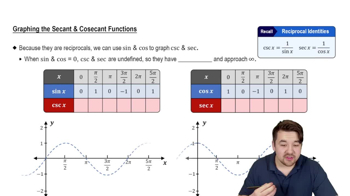
Graphing Reciprocal Functions

The graph of a reciprocal function is obtained by taking the reciprocal of the y-values of the original function. This often introduces vertical asymptotes where the original function crosses zero, since division by zero is undefined. Recognizing these asymptotes and the shape changes is essential for accurate graphing.
Recommended video:
6:22
Graphs of Secant and Cosecant Functions

Equation Identification from Graphs

To write the equation of a reciprocal function from its graph, one must analyze key features such as amplitude, period, phase shift, and vertical shifts of the original sine or cosine function. These parameters directly affect the reciprocal function’s equation, enabling precise formulation based on the transformed graph.
Recommended video:
6:50
Convert Equations from Polar to Rectangular