(Modeling) Fish's View of the World The figure shows a fish's view of the world above the surface of the water. (Data from Walker, J., 'The Amateur Scientist,' Scientific American.) Suppose that a light ray comes from the horizon, enters the water, and strikes the fish's eye. Assume that this ray gives a value of 90° for angle θ₁ in the formula for Snell's law. (In a practical situation, this angle would probably be a little less than 90°.) The speed of light in water is about 2.254 x 10⁸ m per sec. Find angle θ₂ to the nearest tenth.
Table of contents
- 0. Review of College Algebra4h 43m
- 1. Measuring Angles40m
- 2. Trigonometric Functions on Right Triangles2h 5m
- 3. Unit Circle1h 19m
- 4. Graphing Trigonometric Functions1h 19m
- 5. Inverse Trigonometric Functions and Basic Trigonometric Equations1h 41m
- 6. Trigonometric Identities and More Equations2h 34m
- 7. Non-Right Triangles1h 38m
- 8. Vectors2h 25m
- 9. Polar Equations2h 5m
- 10. Parametric Equations1h 6m
- 11. Graphing Complex Numbers1h 7m
- OLD 1. Angles and the Trigonometric Functions Coming soon
- OLD 2. Trigonometric Functions graphs, Inverse Trigonometric Functions Coming soon
- OLD 3. Trigonometric Identities and Equations Coming soon
- OLD 4. Laws of Sines, Cosines and Vectors Coming soon
- OLD 5. Complex Numbers, Polar Coordinates and Parametric Equations Coming soon
- NEW (not used) 7. Laws of Sines, Cosines and Vectors Coming soon
- NEW (not used) 8. Vectors Coming soon
- NEW(not used) 9. Polar equations Coming soon
- NEW (not used) 11. Graphing Complex Numbers Coming soon
3. Unit Circle
Trigonometric Functions on the Unit Circle
Problem 43
Textbook Question
Without using a calculator, determine which of the two values is greater.
cos 2 or sin 2
Verified step by step guidance1
Recall the fundamental trigonometric identity: \(\sin^2 x + \cos^2 x = 1\). This relationship connects sine and cosine values for the same angle.
Express \(\sin 2\) in terms of \(\cos 2\) using the identity. Since \(\sin^2 2 + \cos^2 2 = 1\), we have \(\sin 2 = \pm \sqrt{1 - \cos^2 2}\).
Determine the sign of \(\sin 2\) by considering the angle 2 radians. Since 2 radians is between \(\pi/2\) and \(\pi\) (approximately 1.57 to 3.14), \(\sin 2\) is positive in this interval.
Estimate the approximate values of \(\cos 2\) and \(\sin 2\) without a calculator by recalling the unit circle or known values: \(\cos 2\) is negative (since 2 radians is in the second quadrant), and \(\sin 2\) is positive.
Compare the two values based on their signs and approximate magnitudes: since \(\cos 2\) is negative and \(\sin 2\) is positive, conclude which is greater without calculating exact values.
Verified video answer for a similar problem:This video solution was recommended by our tutors as helpful for the problem above
Play a video:
0 Comments
Key Concepts
Here are the essential concepts you must grasp in order to answer the question correctly.
Understanding the Range and Behavior of Sine and Cosine Functions
Sine and cosine functions oscillate between -1 and 1. Knowing their values at specific angles, especially in radians, helps compare their magnitudes. Since 2 radians is between π/2 and π, sine and cosine have predictable signs and approximate values in this interval.
Recommended video:
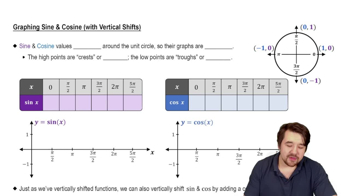
Graph of Sine and Cosine Function
Evaluating Trigonometric Functions at Specific Angles Without a Calculator
Estimating sine and cosine values at non-standard angles involves understanding the unit circle and reference angles. For 2 radians, which is about 114.6°, sine is positive and cosine is negative, allowing qualitative comparison without exact calculation.
Recommended video:
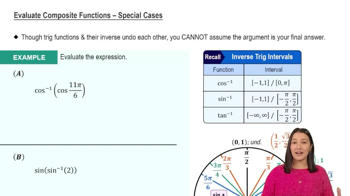
Evaluate Composite Functions - Special Cases
Comparing Numerical Values of Trigonometric Functions
To determine which value is greater, compare the approximate magnitudes and signs of sine and cosine at the given angle. Since cosine 2 is negative and sine 2 is positive, sine 2 is greater, illustrating the importance of sign and magnitude in comparisons.
Recommended video:
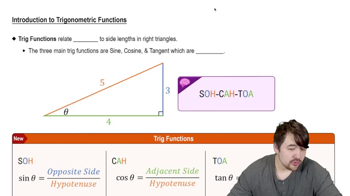
Introduction to Trigonometric Functions
Related Videos
Related Practice
Textbook Question
1
views
