Which of the following best describes the graph of the polar equation ?
Table of contents
- 0. Review of College Algebra4h 43m
- 1. Measuring Angles40m
- 2. Trigonometric Functions on Right Triangles2h 5m
- 3. Unit Circle1h 19m
- 4. Graphing Trigonometric Functions1h 19m
- 5. Inverse Trigonometric Functions and Basic Trigonometric Equations1h 41m
- 6. Trigonometric Identities and More Equations2h 34m
- 7. Non-Right Triangles1h 38m
- 8. Vectors2h 25m
- 9. Polar Equations2h 5m
- 10. Parametric Equations1h 6m
- 11. Graphing Complex Numbers1h 7m
- OLD 1. Angles and the Trigonometric Functions Coming soon
- OLD 2. Trigonometric Functions graphs, Inverse Trigonometric Functions Coming soon
- OLD 3. Trigonometric Identities and Equations Coming soon
- OLD 4. Laws of Sines, Cosines and Vectors Coming soon
- OLD 5. Complex Numbers, Polar Coordinates and Parametric Equations Coming soon
- NEW (not used) 7. Laws of Sines, Cosines and Vectors Coming soon
- NEW (not used) 8. Vectors Coming soon
- NEW(not used) 9. Polar equations Coming soon
- NEW (not used) 11. Graphing Complex Numbers Coming soon
9. Polar Equations
Graphing Other Common Polar Equations
Problem 5.RE.65
Textbook Question
In Exercises 64–70, graph each polar equation. Be sure to test for symmetry. r = 2 + 2 sin θ
Verified step by step guidance1
Identify the given polar equation: \(r = 2 + 2 \sin \theta\).
Recall that \(r\) represents the radius (distance from the origin) and \(\theta\) is the angle measured from the positive x-axis in polar coordinates.
Test for symmetry by checking the following:
- Symmetry about the polar axis (x-axis): Replace \(\theta\) with \(-\theta\) and see if the equation remains unchanged.
- Symmetry about the line \(\theta = \frac{\pi}{2}\) (y-axis): Replace \(\theta\) with \(\pi - \theta\).
- Symmetry about the pole (origin): Replace \(r\) with \(-r\) and \(\theta\) with \(\theta + \pi\).
Create a table of values by choosing several values of \(\theta\) (for example, \(0\), \(\frac{\pi}{6}\), \(\frac{\pi}{4}\), \(\frac{\pi}{2}\), etc.) and calculate the corresponding \(r\) values using the equation \(r = 2 + 2 \sin \theta\).
Plot the points \((r, \theta)\) on polar graph paper or using a graphing tool, then connect the points smoothly to visualize the curve. Observe the shape and symmetry based on your earlier tests.
Verified video answer for a similar problem:This video solution was recommended by our tutors as helpful for the problem above
Video duration:
6mPlay a video:
0 Comments
Key Concepts
Here are the essential concepts you must grasp in order to answer the question correctly.
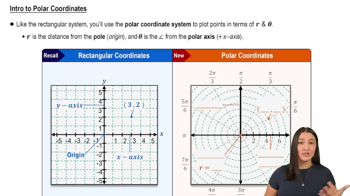
Polar Coordinates and Equations
Polar coordinates represent points in a plane using a radius and an angle (r, θ) instead of Cartesian coordinates (x, y). A polar equation expresses the radius r as a function of the angle θ, allowing the graph to be plotted by calculating r for various θ values.
Recommended video:
Intro to Polar Coordinates
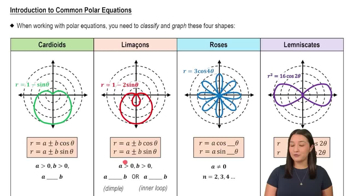
Graphing Polar Equations
To graph a polar equation like r = 2 + 2 sin θ, calculate r for multiple θ values between 0 and 2π, then plot the points in polar form. Connecting these points reveals the shape, which often corresponds to known curves such as limacons or cardioids.
Recommended video:
Introduction to Common Polar Equations
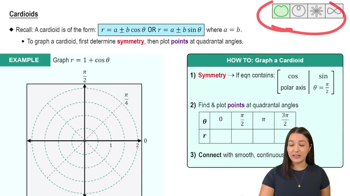
Symmetry in Polar Graphs
Testing for symmetry helps simplify graphing and understanding polar curves. Common symmetries include symmetry about the polar axis (θ = 0), the line θ = π/2, and the pole (origin). Checking if replacing θ with -θ, π - θ, or θ + π yields the same equation indicates these symmetries.
Recommended video:
Cardioids
Related Videos
Related Practice
Multiple Choice