In Exercises 21–28, an object moves in simple harmonic motion described by the given equation, where t is measured in seconds and d in inches. In each exercise, find the following: a. the maximum displacement b. the frequency c. the time required for one cycle. d = −4 sin 3π/2 t

Blitzer 3rd Edition
Ch. 2 - Graphs of the Trigonometric Functions; Inverse Trigonometric Functions
Problem 27Determine the amplitude, period, and phase shift of each function. Then graph one period of the function.
y = 3 sin(πx + 2)
Verified step by step guidance
Verified video answer for a similar problem:
Key Concepts
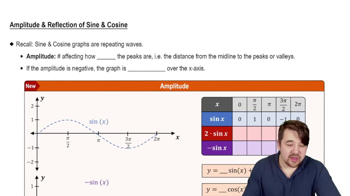
Amplitude of a Sine Function
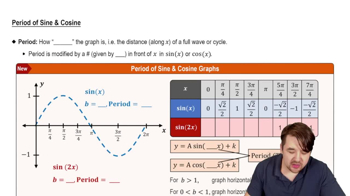
Period of a Sine Function
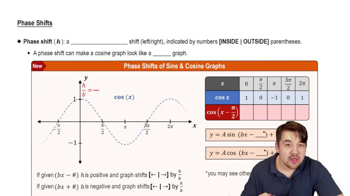
Phase Shift of a Sine Function
In Exercises 21–28, an object moves in simple harmonic motion described by the given equation, where t is measured in seconds and d in inches. In each exercise, find the following: a. the maximum displacement b. the frequency c. the time required for one cycle. d = 1/3 sin 2t
In Exercises 27–38, use a calculator to find the value of each expression rounded to two decimal places. sin⁻¹ 0.3
In Exercises 29–44, graph two periods of the given cosecant or secant function. y = 3 csc x
Use each graph to obtain the graph of the corresponding reciprocal function, cosecant or secant. Give the equation of the function for the graph that you obtain.
<IMAGE>
In Exercises 25–28, use each graph to obtain the graph of the corresponding reciprocal function, cosecant or secant. Give the equation of the function for the graph that you obtain.