Solve each problem. (Source for Exercises 49 and 50: Parker, M., Editor, She Does Math, Mathematical Association of America.) Length of Sides of an Isosceles Triangle An isosceles triangle has a base of length 49.28 m. The angle opposite the base is 58.746°. Find the length of each of the two equal sides.
Table of contents
- 0. Review of College Algebra4h 43m
- 1. Measuring Angles40m
- 2. Trigonometric Functions on Right Triangles2h 5m
- 3. Unit Circle1h 19m
- 4. Graphing Trigonometric Functions1h 19m
- 5. Inverse Trigonometric Functions and Basic Trigonometric Equations1h 41m
- 6. Trigonometric Identities and More Equations2h 34m
- 7. Non-Right Triangles1h 38m
- 8. Vectors2h 25m
- 9. Polar Equations2h 5m
- 10. Parametric Equations1h 6m
- 11. Graphing Complex Numbers1h 7m
- OLD 1. Angles and the Trigonometric Functions Coming soon
- OLD 2. Trigonometric Functions graphs, Inverse Trigonometric Functions Coming soon
- OLD 3. Trigonometric Identities and Equations Coming soon
- OLD 4. Laws of Sines, Cosines and Vectors Coming soon
- OLD 5. Complex Numbers, Polar Coordinates and Parametric Equations Coming soon
- NEW (not used) 7. Laws of Sines, Cosines and Vectors Coming soon
- NEW (not used) 8. Vectors Coming soon
- NEW(not used) 9. Polar equations Coming soon
- NEW (not used) 11. Graphing Complex Numbers Coming soon
2. Trigonometric Functions on Right Triangles
Trigonometric Functions on Right Triangles
Problem 60
Textbook Question
Solve each problem. (Source for Exercises 49 and 50: Parker, M., Editor, She Does Math, Mathematical Association of America.) Create a right triangle problem whose solution can be found by evaluating θ if sin θ = ¾.
Verified step by step guidance1
Understand that the problem asks to create a right triangle where the angle \( \theta \) satisfies \( \sin \theta = \frac{3}{4} \). Recall that \( \sin \theta = \frac{\text{opposite side}}{\text{hypotenuse}} \) in a right triangle.
Assign the opposite side length as 3 units and the hypotenuse as 4 units, based on the sine ratio \( \sin \theta = \frac{3}{4} \).
Use the Pythagorean theorem to find the length of the adjacent side: \( \text{adjacent} = \sqrt{\text{hypotenuse}^2 - \text{opposite}^2} = \sqrt{4^2 - 3^2} \).
Express the problem: "In a right triangle, the side opposite angle \( \theta \) is 3 units, and the hypotenuse is 4 units. Find \( \theta \) by evaluating \( \sin^{-1} \left( \frac{3}{4} \right) \)."
To solve for \( \theta \), use the inverse sine function: \( \theta = \sin^{-1} \left( \frac{3}{4} \right) \). This step completes the setup for finding the angle \( \theta \).
Verified video answer for a similar problem:This video solution was recommended by our tutors as helpful for the problem above
Video duration:
3mPlay a video:
0 Comments
Key Concepts
Here are the essential concepts you must grasp in order to answer the question correctly.
Right Triangle and Trigonometric Ratios
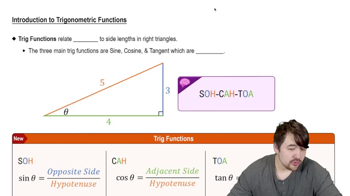
A right triangle has one 90-degree angle, and its sides relate through trigonometric ratios like sine, cosine, and tangent. The sine of an angle θ is the ratio of the length of the side opposite θ to the hypotenuse. Understanding this relationship allows solving for unknown sides or angles.
Recommended video:
Introduction to Trigonometric Functions
Inverse Sine Function (sin⁻¹ or arcsin)
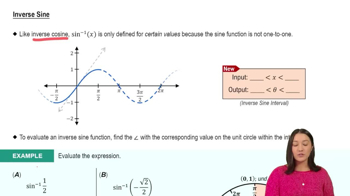
The inverse sine function is used to find the angle θ when the sine value is known. Given sin θ = 3/4, θ can be found by calculating θ = sin⁻¹(3/4). This function returns an angle in the range of -90° to 90°, which corresponds to the angle in a right triangle.
Recommended video:
Inverse Sine
Constructing a Right Triangle from a Given Ratio
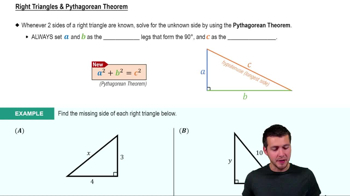
To create a right triangle problem from sin θ = 3/4, assign side lengths consistent with this ratio, such as opposite side = 3 units and hypotenuse = 4 units. Using the Pythagorean theorem, the adjacent side can be found, enabling full characterization of the triangle and solving related problems.
Recommended video:
Guided course
Solving Right Triangles with the Pythagorean Theorem
Related Videos
Related Practice
Textbook Question
1
views