Ch. 5 - Complex Numbers, Polar Coordinates and Parametric Equations
Blitzer - Trigonometry 3rd Edition
Blitzer3rd EditionTrigonometryISBN: 9780137316601Not the one you use?Change textbook
Chapter 5, Problem 41

In Exercises 37–44, find the product of the complex numbers. Leave answers in polar form. z₁ = cos π/4 + i sin π/4 z₂ = cos π/3 + i sin π/3

Verified step by step guidance
1
Recall that complex numbers in the form \(z = \cos \theta + i \sin \theta\) are expressed in polar form, where \(\theta\) is the argument (angle) of the complex number.
To find the product of two complex numbers in polar form, use the formula: if \(z_1 = \cos \alpha + i \sin \alpha\) and \(z_2 = \cos \beta + i \sin \beta\), then their product is \(z_1 z_2 = \cos(\alpha + \beta) + i \sin(\alpha + \beta)\).
Identify the angles for the given complex numbers: \(\alpha = \frac{\pi}{4}\) for \(z_1\) and \(\beta = \frac{\pi}{3}\) for \(z_2\).
Add the angles: calculate \(\alpha + \beta = \frac{\pi}{4} + \frac{\pi}{3}\), which will be the argument of the product.
Write the product in polar form as \(z_1 z_2 = \cos\left(\frac{\pi}{4} + \frac{\pi}{3}\right) + i \sin\left(\frac{\pi}{4} + \frac{\pi}{3}\right)\).

Verified video answer for a similar problem:

This video solution was recommended by our tutors as helpful for the problem above.
Video duration:
4m
Was this helpful?

Key Concepts

Here are the essential concepts you must grasp in order to answer the question correctly.

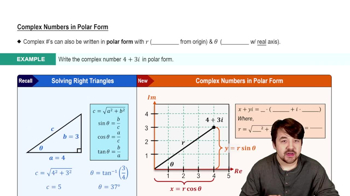
Complex Numbers in Polar Form

Complex numbers can be expressed in polar form as r(cos θ + i sin θ), where r is the magnitude and θ is the argument (angle). This form highlights the geometric interpretation of complex numbers as points or vectors in the plane, making multiplication and division more intuitive.
Recommended video:
04:47
Complex Numbers In Polar Form

Multiplication of Complex Numbers in Polar Form

When multiplying two complex numbers in polar form, multiply their magnitudes and add their angles. Specifically, if z₁ = r₁(cos θ₁ + i sin θ₁) and z₂ = r₂(cos θ₂ + i sin θ₂), then z₁z₂ = r₁r₂ [cos(θ₁ + θ₂) + i sin(θ₁ + θ₂)]. This simplifies the product calculation significantly.
Recommended video:
04:47
Complex Numbers In Polar Form

Euler's Formula and Trigonometric Representation

Euler's formula states that e^(iθ) = cos θ + i sin θ, linking exponential and trigonometric forms of complex numbers. This connection helps understand the polar form and the behavior of complex multiplication as rotation and scaling in the complex plane.
Recommended video:
6:36
Quadratic Formula