Give the exact value of each expression. See Example 5. sin 30°
Verified step by step guidance
1
Recall the definition of the sine function in a right triangle: \(\sin \theta = \frac{\text{opposite side}}{\text{hypotenuse}}\).
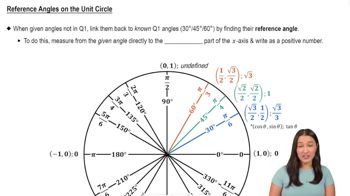
Recognize that 30° is a special angle in trigonometry, often associated with well-known exact values.
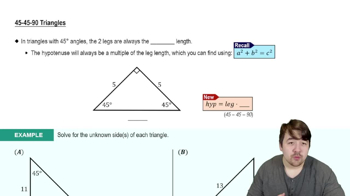
Use the known exact value for \(\sin 30^\circ\), which comes from the properties of a 30°-60°-90° triangle.
Recall that in a 30°-60°-90° triangle, the side opposite 30° is half the length of the hypotenuse.
Therefore, \(\sin 30^\circ = \frac{1}{2}\).
Verified video answer for a similar problem:
This video solution was recommended by our tutors as helpful for the problem above
Video duration:
1m
Play a video:
0 Comments
Key Concepts
Here are the essential concepts you must grasp in order to answer the question correctly.
Definition of the Sine Function
The sine of an angle in a right triangle is the ratio of the length of the side opposite the angle to the hypotenuse. It is a fundamental trigonometric function used to relate angles to side lengths.
Certain angles like 30°, 45°, and 60° have well-known exact sine values derived from special triangles. For example, sin 30° equals 1/2, which is often memorized or derived from an equilateral triangle split in half.
Reference triangles, such as the 30°-60°-90° triangle, help determine exact trigonometric values without a calculator. Understanding their side ratios allows for precise computation of sine, cosine, and tangent values.

 1:34 minutes
 Verified step by step guidance
 5:53
5:53