Ch. 2 - Acute Angles and Right Triangles
Lial - Trigonometry 12th Edition
Lial12th EditionTrigonometryISBN: 9780136552161Not the one you use?Change textbook
Chapter 3, Problem 77

Find a formula for the area of each figure in terms of s.

Verified step by step guidance
1
Identify the type of figure you are working with (e.g., square, triangle, circle) since the formula for area depends on the shape.
Recall the general formula for the area of the identified figure. For example, for a square, the area is \(A = s^2\), where \(s\) is the length of a side.
Express all necessary dimensions of the figure in terms of \(s\). For instance, if the figure is an equilateral triangle, the height can be expressed using the Pythagorean theorem as \(h = \frac{\sqrt{3}}{2} s\).
Substitute the expressions involving \(s\) into the area formula. For the equilateral triangle, the area formula becomes \(A = \frac{1}{2} \times s \times h = \frac{1}{2} \times s \times \frac{\sqrt{3}}{2} s\).
Simplify the expression to get the area entirely in terms of \(s\). This will give you a formula that you can use to calculate the area for any given side length \(s\).

Verified video answer for a similar problem:

This video solution was recommended by our tutors as helpful for the problem above.
Video duration:
2m
Was this helpful?

Key Concepts

Here are the essential concepts you must grasp in order to answer the question correctly.

Area Formulas for Geometric Figures

Understanding the standard formulas for the area of common geometric shapes (such as squares, triangles, rectangles, and circles) is essential. These formulas often involve side lengths or other dimensions, and knowing how to express area in terms of a given variable like s is key.
Recommended video:
4:30
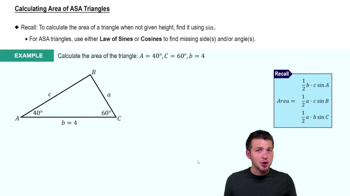
Calculating Area of ASA Triangles

Expressing Variables in Terms of s

To write the area formula in terms of s, you must identify how all relevant dimensions relate to s. This may involve substituting expressions or using properties of the figure to rewrite lengths, heights, or radii as functions of s.
Recommended video:
5:28
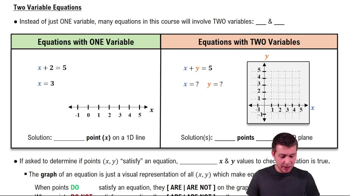
Equations with Two Variables

Trigonometric Relationships in Area Calculation

For figures like triangles or polygons where angles are involved, trigonometric functions (sine, cosine) help find heights or other lengths needed for area formulas. Using these relationships allows expressing the area in terms of s and known angles.
Recommended video:
4:30
Calculating Area of ASA Triangles