CONCEPT PREVIEW Work each problem. Match each polynomial in Column I with its factored form in Column II. I II a. 8x³ - 27 A. (3 - 2x) (9 + 6x + 4x²) b. 8x³ + 27 B. (2x - 3) (4x² + 6x + 9) c. 27 - 8x³ C. (2x + 3) (4x² - 6x + 9)
Ch. R - Algebra Review
Chapter 1, Problem 3
CONCEPT PREVIEW Fill in the blank(s) to correctly complete each sentence. The opposite, or negative, of a number is its _______.
Verified step by step guidance1
This problem is about understanding the concept of the opposite, or negative, of a number, which is a fundamental idea in mathematics but not directly a trigonometry problem.
The opposite of a number refers to the value that, when added to the original number, results in zero. This is also known as the additive inverse.
For example, the opposite of a positive number is its negative counterpart, and the opposite of a negative number is its positive counterpart.
In mathematical terms, if the number is \(x\), then its opposite is \(-x\), because \(x + (-x) = 0\).
Therefore, the blank should be filled with the term 'additive inverse' or simply 'additive inverse of the number'.

Verified video answer for a similar problem:
This video solution was recommended by our tutors as helpful for the problem above.
Video duration:
1mWas this helpful?
Key Concepts
Here are the essential concepts you must grasp in order to answer the question correctly.
Opposite (Additive Inverse) of a Number
The opposite of a number, also called its additive inverse, is the number that when added to the original number results in zero. For example, the opposite of 5 is -5 because 5 + (-5) = 0.
Recommended video:
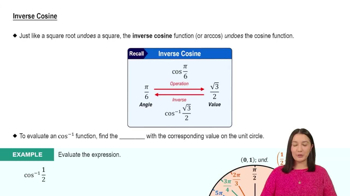
Inverse Cosine
Negative of a Number
The negative of a number is the value with the same magnitude but opposite sign. It is essentially the number multiplied by -1. For instance, the negative of 7 is -7.
Recommended video:
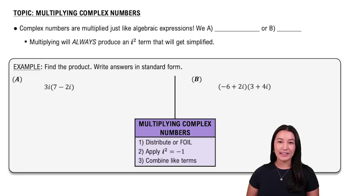
Multiplying Complex Numbers
Number Line Representation
On the number line, the opposite of a number is located the same distance from zero but in the opposite direction. This visual helps understand why opposites have equal magnitude but different signs.
Recommended video:
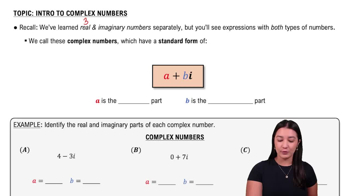
Introduction to Complex Numbers
Related Practice
Textbook Question
Textbook Question
CONCEPT PREVIEW Which of the following is the correct factorization of x⁴ - 1? A. (x² - 1) (x² + 1) B. (x² + 1) (x + 1) (x - 1) C. (x² - 1)² D. (x - 1)² (x + 1)²
3
views
Textbook Question
Simplify each expression. See Example 1. (½ mn) (8m²n²)
3
views
Textbook Question
Fill in the blank(s) to correctly complete each sentence.
The graph of ƒ(x) = (x + 4)² is obtained by shifting the graph of y = x² to the ___ 4 units.
17
views
Textbook Question
Simplify each expression. See Example 8. 10x (3)(y)
Textbook Question
Find the given distances between points P, Q, R, and S on a number line, with coordinates -4, -1, 8, and 12, respectively. See Example 3. d (Q, R)
1
views