For each expression in Column I, choose the expression from Column II that completes an identity. 6. sec² x = ____
II A. sin ^2 x/cos ^2 x B.1/(sec ^2 x) C. sin (-x) D. csc ^2 x-cot ^2 x + sin ^2 x E. tan x
Verified step by step guidance
1
Recall the Pythagorean identity involving secant and tangent: \(\sec^2 x = 1 + \tan^2 x\).
Understand that this identity comes from dividing the fundamental identity \(\sin^2 x + \cos^2 x = 1\) by \(\cos^2 x\).
Rewrite the expression \(\sec^2 x\) in terms of tangent using the identity: \(\sec^2 x = 1 + \tan^2 x\).
Compare the given expression \(\sec^2 x\) with the options in Column II to find the one that matches \(1 + \tan^2 x\).
Select the expression from Column II that completes the identity as \(1 + \tan^2 x\).
Verified video answer for a similar problem:
This video solution was recommended by our tutors as helpful for the problem above
Play a video:
0 Comments
Key Concepts
Here are the essential concepts you must grasp in order to answer the question correctly.
Pythagorean Identity
The Pythagorean identities relate the squares of sine, cosine, and secant functions. One key identity is 1 + tan²x = sec²x, which expresses sec²x in terms of tan²x. This identity is fundamental for transforming and simplifying trigonometric expressions.
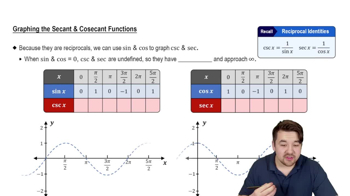
Secant (sec x) is the reciprocal of cosine, defined as sec x = 1/cos x. Understanding this reciprocal relationship helps in manipulating expressions involving sec²x and connecting them to other trigonometric functions like cosine and tangent.
Squaring trigonometric functions, such as sec²x or tan²x, is common in identities and equations. Recognizing how these squares relate through identities allows for simplification and solving of trigonometric problems effectively.

 Verified step by step guidance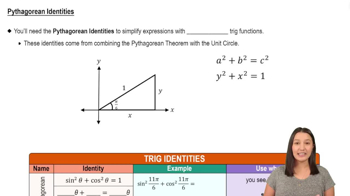
 6:25
6:25