Convert each radian measure to degrees. See Examples 2(a) and 2(b). ―7π/20
Verified step by step guidance
1
Recall the conversion formula between radians and degrees: \(\text{degrees} = \text{radians} \times \frac{180}{\pi}\).
Identify the given radian measure: \(-\frac{7\pi}{20}\).
Substitute the radian value into the conversion formula: \(-\frac{7\pi}{20} \times \frac{180}{\pi}\).
Simplify the expression by canceling \(\pi\) in numerator and denominator: \(-\frac{7}{20} \times 180\).
Multiply the numbers to find the degree measure (do not calculate the final value here, just set up the multiplication).
Verified video answer for a similar problem:
This video solution was recommended by our tutors as helpful for the problem above
Play a video:
0 Comments
Key Concepts
Here are the essential concepts you must grasp in order to answer the question correctly.
Radian Measure
A radian is a unit of angular measure based on the radius of a circle. One radian is the angle subtended at the center of a circle by an arc equal in length to the radius. Radians provide a natural way to measure angles in terms of the circle's geometry.
To convert radians to degrees, multiply the radian measure by 180/π. This conversion works because 180 degrees is equivalent to π radians. For example, to convert -7π/20 radians, multiply by 180/π to get the degree measure.
When converting angles expressed as fractions of π, it is important to simplify the fraction after multiplication to get a clear degree value. This often involves multiplying numerators and denominators and reducing the fraction to its simplest form for easier interpretation.

 Verified step by step guidance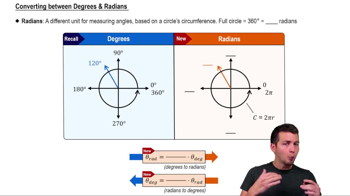
 5:04
5:04