Use trigonometric function values of quadrantal angles to evaluate each expression. 3 sec 180° ― 5 tan 360°
Verified step by step guidance
1
Recall the definitions and values of trigonometric functions at quadrantal angles: 180° and 360° are on the x-axis of the unit circle, where sine and cosine take specific values.
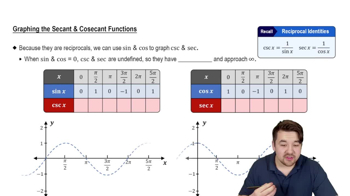
Evaluate \( \sec 180^\circ \). Since \( \sec \theta = \frac{1}{\cos \theta} \), first find \( \cos 180^\circ \), then take its reciprocal.
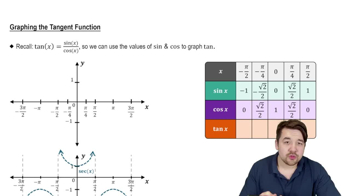
Evaluate \( \tan 360^\circ \). Recall that \( \tan \theta = \frac{\sin \theta}{\cos \theta} \), so find \( \sin 360^\circ \) and \( \cos 360^\circ \) and compute their ratio.
Multiply the value of \( \sec 180^\circ \) by 3, and multiply the value of \( \tan 360^\circ \) by 5, as indicated in the expression.
Subtract the product \( 5 \tan 360^\circ \) from \( 3 \sec 180^\circ \) to get the final expression value.
Verified video answer for a similar problem:
This video solution was recommended by our tutors as helpful for the problem above
Video duration:
3m
Play a video:
0 Comments
Key Concepts
Here are the essential concepts you must grasp in order to answer the question correctly.
Quadrantal Angles
Quadrantal angles are angles that lie on the x- or y-axis in the coordinate plane, typically 0°, 90°, 180°, 270°, and 360°. Their trigonometric function values are special and often involve 0, ±1, or undefined values, which simplifies calculations.
The secant function is the reciprocal of the cosine function, defined as sec θ = 1/cos θ. Evaluating secant at quadrantal angles requires knowing the cosine values at those angles, which can be 0 or ±1, affecting whether secant is defined or undefined.
The tangent function is the ratio of sine to cosine, tan θ = sin θ / cos θ. At quadrantal angles, tangent values can be 0, undefined, or ±1, depending on the sine and cosine values, which is crucial for correctly evaluating expressions involving tan 360°.

 3:37 minutes
 Verified step by step guidance
 6:36
6:36